On June 15, 2026, a tragic Boeing B-52H Stratofortress crash at Edwards Air Force Base in California killed all eight crew members aboard. The catastrophe has immediately renewed fierce debates regarding the safety, structural integrity, and long-term viability of the United States Air Force’s most legendary, aging heavy bomber.
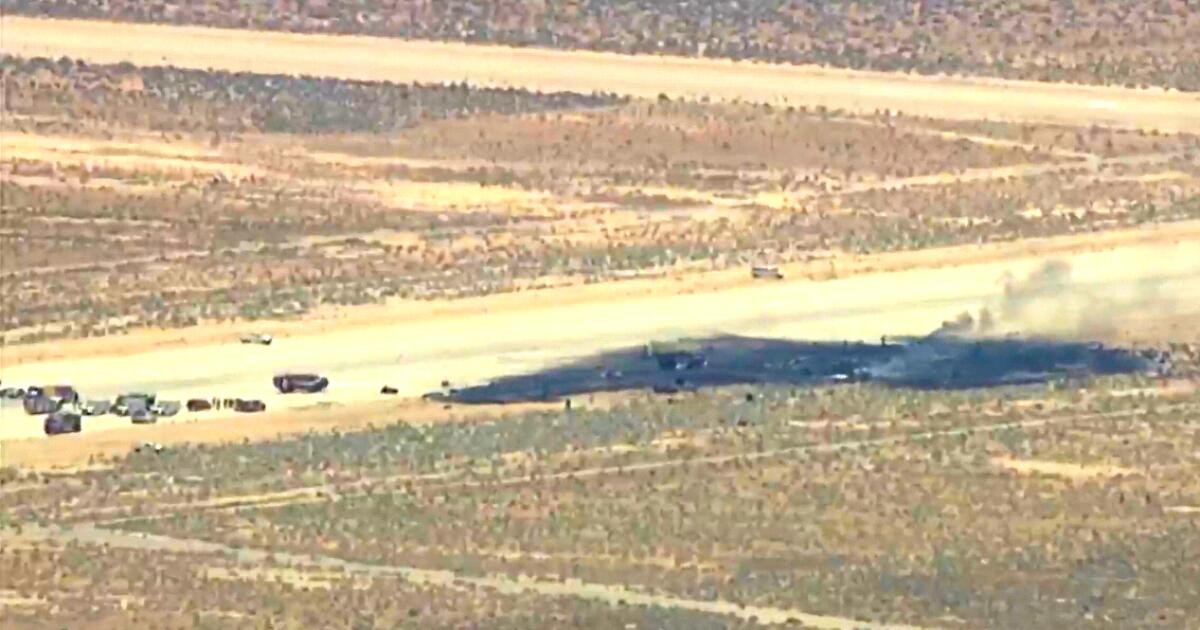
The aircraft (Registration: 60-0061, historically nicknamed “The Spirit of Aggieland II”) went down at 11:20 AM PDT just moments after takeoff. Early flight-tracking data indicates that the massive, eight-engine jet made a sharp right turn, followed by an abrupt 180-degree pivot, before plunging toward a parallel runway at a terrifying rate of 5,056 feet per minute—nearly ten times the speed of a normal landing descent. The resulting post-crash fire was so intense that aerial footage revealed virtually no recognizable fuselage remaining on the blackened desert floor.
The Crux of the Concern: The Modernization Dilemma
The primary reason this specific crash is raising alarm bells across the defense community is that the flight was not a routine training run; it was a high-priority test sortie for the Air Force’s Radar Modernization Program.
The B-52 Stratofortress first entered active service in 1955. Because of its massive payload capacity and unparalleled range, the Pentagon plans to keep the fleet flying through at least 2050—meaning these airframes will be nearly a century old by the time they are retired. To achieve this, the Air Force is currently executing multi-billion dollar overhauls, which include:
- Integrating advanced Active Electronically Scanned Array (AESA) radar systems.
- Completely replacing the legacy Pratt & Whitney TF33 engines with modern Rolls-Royce F130 engines (scheduled to begin major modifications later this year).
Aviation safety experts, including former FAA and NTSB investigator Jeff Guzzetti, have noted that the rapid loss of control right after takeoff strongly points toward a severe controllability issue. Investigators are focusing heavily on whether a critical flight control malfunction occurred, if the controls were rigged incorrectly during the recent radar installation maintenance, or if a piece of experimental testing equipment catastrophically failed.
The Human and Operational Toll
The crash is the deadliest incident involving a Stratofortress since a 1982 crash at Mather Air Force Base. Because it was a highly technical development flight, the eight casualties represent a devastating loss of specialized expertise, including:
- Uniformed Air Force military personnel.
- Government civilian engineers.
- Private defense contractors (with Boeing confirming that two of its direct employees were among the dead).
Colonel James Hayes, deputy commander of the 412th Test Wing, stated that a formal accident investigation board has been established, though pinning down an exact cause could take up to six months due to the lack of physical evidence left behind by the fire.
As the Pentagon mourns the loss of the crew, defense analysts are closely watching to see if this disaster will force a temporary grounding of the testing fleet or trigger extensive delays for the B-52 modernization roadmap—a timeline that is absolutely critical to maintaining the airborne leg of the U.S. nuclear triad.