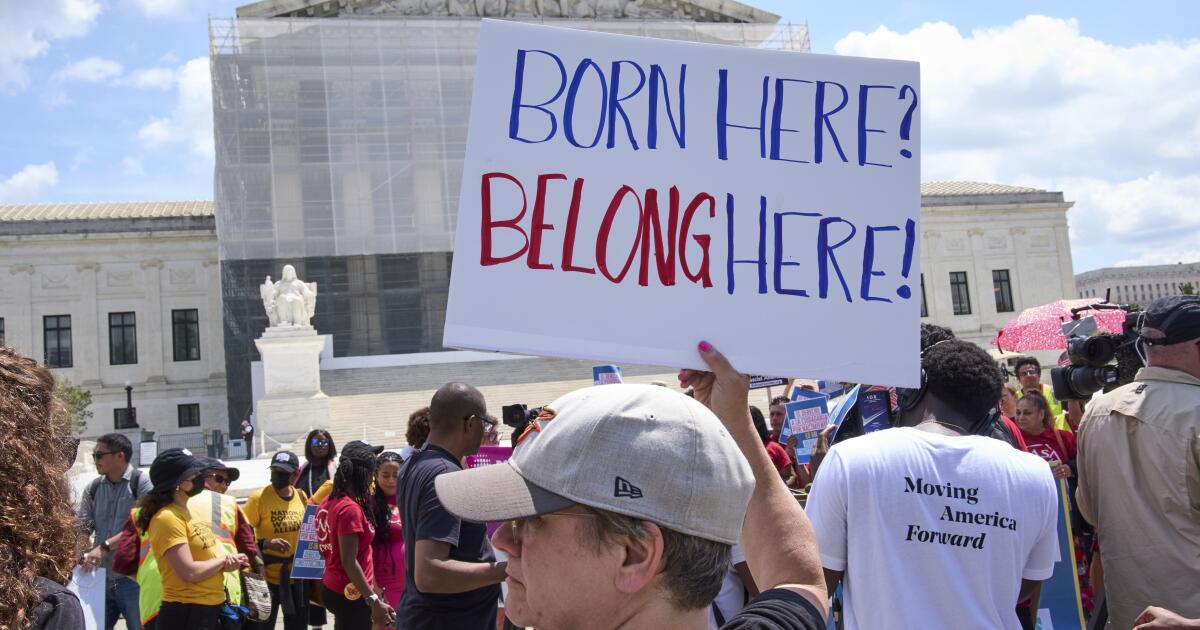
The Supreme Court’s landmark 6–3 ruling in Trump v. Barbara struck down a signature executive order designed to end automatic birthright citizenship for children born to undocumented or temporary-status parents.
The decision is being widely hailed by civil rights advocates as a monumental win for the rule of law and democratic norms. At the same time, the legal architecture of the decision and the sheer fact that it reached the High Court serve as a sobering warning about the fragile state of constitutional guardrails.
The Win: A Reaffirmation of the 14th Amendment
The majority opinion, authored by Chief Justice John Roberts, forcefully defended a 150-year-old consensus rooted in the post-Civil War Reconstruction era. The ruling firmly shut down the administration’s attempt to use executive power to narrow the Citizenship Clause of the Fourteenth Amendment.
- The Core Legal Text: The administration argued that children of noncitizens are not truly “subject to the jurisdiction” of the U.S. and therefore not entitled to automatic citizenship. The Court resoundingly rejected this, reiterating that anyone physically present and bound by U.S. laws is subject to its jurisdiction.
- Rejecting Executive Fiat: The ruling serves as a massive check on presidential power, clarifying that a president cannot rewrite the foundational elements of American identity or upend constitutional text by signing a decree.
- Bipartisan Coalition: Roberts was joined by the court’s three liberal justices, alongside conservative Trump appointees Amy Coney Barrett and Brett Kavanaugh (who concurred in the judgment, finding the order violated federal law).
The Warning: The Structural Fractures Exposed
While the outcome protected the status quo, the underlying mechanics of the case reveal why many legal scholars and advocates view the ruling as a systemic warning sign:
1. Bloodline as a Legal Argument
In her concurring opinion, Justice Ketanji Brown Jackson noted that the 14th Amendment was explicitly designed to prevent “bloodline” or ancestry from being the marker of American belonging. The warning here is how close the country came to establishing a permanent, multi-generational legal underclass of individuals born on American soil but denied basic human and civil rights.
2. A Fragmented Court
What many legal scholars believed should have been a unanimous 9–0 defense of settled constitutional law instead resulted in a fractured 6–3 split.
- The Dissents: Justices Clarence Thomas, Samuel Alito, and Neil Gorsuch dissented. Justice Thomas alone penned a massive, nearly 90-page dissenting opinion—the longest of his career—vindicating the administration’s fringe legal interpretation.
- The Political Signal: The fact that three sitting Supreme Court justices were willing to entertain a unilateral executive overhaul of the 14th Amendment signals that birthright citizenship remains a live political target, likely to be pushed through future legislative efforts or constitutional challenges.
3. A Fractured Immigration Landscape
Advocates warn that celebrating this single victory shouldn’t obscure the broader executive crackdown. Just days prior to this ruling, the same conservative judicial majority handed down several decisions favoring the administration’s immigration agenda, including upholding the unilateral termination of Temporary Protected Status (TPS) for hundreds of thousands of migrants.
The Takeaway: Trump v. Barbara proved that the Constitution still holds the line against unilateral executive overreach. However, the ruling also acts as an flashing yellow light: it showed that norms previously thought to be completely immutable are now open to active legal debate at the highest levels of government.