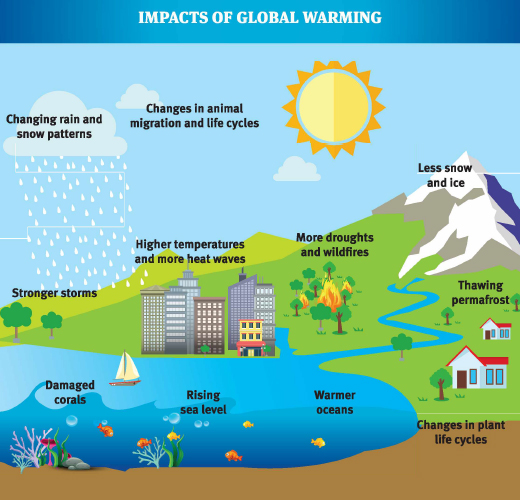
Climate change impacts refer to the observed and projected effects of rising global temperatures and shifting climate patterns driven primarily by human greenhouse gas emissions.
Observed Impacts
Global average surface temperatures have risen by roughly 1.1–1.3°C above pre-industrial levels. This warming is already producing measurable changes across multiple systems:
- Extreme weather — More frequent and intense heatwaves, heavier rainfall events in some regions, and longer, more severe droughts in others. Wildfire seasons in the western United States have lengthened and intensified, as seen in the large fires near Spokane, Washington, in early August 2026 that forced nearly 65,000 evacuations and destroyed hundreds of structures.
- Sea-level rise — Global mean sea level has risen approximately 20–25 cm since 1900, with the rate accelerating in recent decades due to thermal expansion of seawater and melting of glaciers and ice sheets.
- Cryosphere changes — Significant loss of Arctic sea ice, retreat of mountain glaciers, and accelerated melting of the Greenland and Antarctic ice sheets.
- Ecosystems — Shifts in species ranges, coral bleaching events, and changes in the timing of seasonal events (phenology) such as earlier springs in many temperate regions.
Impacts on Human Systems
- Agriculture and food security — Changing precipitation patterns, heat stress on crops, and increased pest pressure affect yields in many regions. Some high-latitude areas may see temporary gains, while tropical and subtropical regions face greater risks.
- Water resources — Altered snowpack, earlier snowmelt, and more variable rainfall affect water availability for cities, agriculture, and hydropower.
- Human health — Increased heat-related illness and mortality, expanded ranges of certain vector-borne diseases, and mental health effects linked to extreme weather and displacement.
- Infrastructure and economy — Coastal flooding, damage from storms and wildfires, and stress on energy systems raise costs for governments, insurers, and households.
Regional Variation
Impacts are not uniform. The Arctic is warming several times faster than the global average. Small island nations and low-lying coastal areas face existential risks from sea-level rise. Parts of the western United States, southern Europe, the Mediterranean, and regions of Africa and Australia have experienced more severe drought and wildfire conditions.
Outlook
Further warming is expected this century under all emissions scenarios, though the magnitude depends strongly on future greenhouse gas trajectories. Limiting warming closer to 1.5°C would substantially reduce risks compared with higher pathways, according to assessments by the Intergovernmental Panel on Climate Change (IPCC) and national scientific bodies.
Adaptation measures (improved early warning systems, resilient infrastructure, water management, and land-use planning) are already underway in many places, alongside efforts to reduce emissions.
Would you like a deeper focus on a specific region (e.g., United States), sector (agriculture, health, coasts), or a news-style article on recent climate-related events?