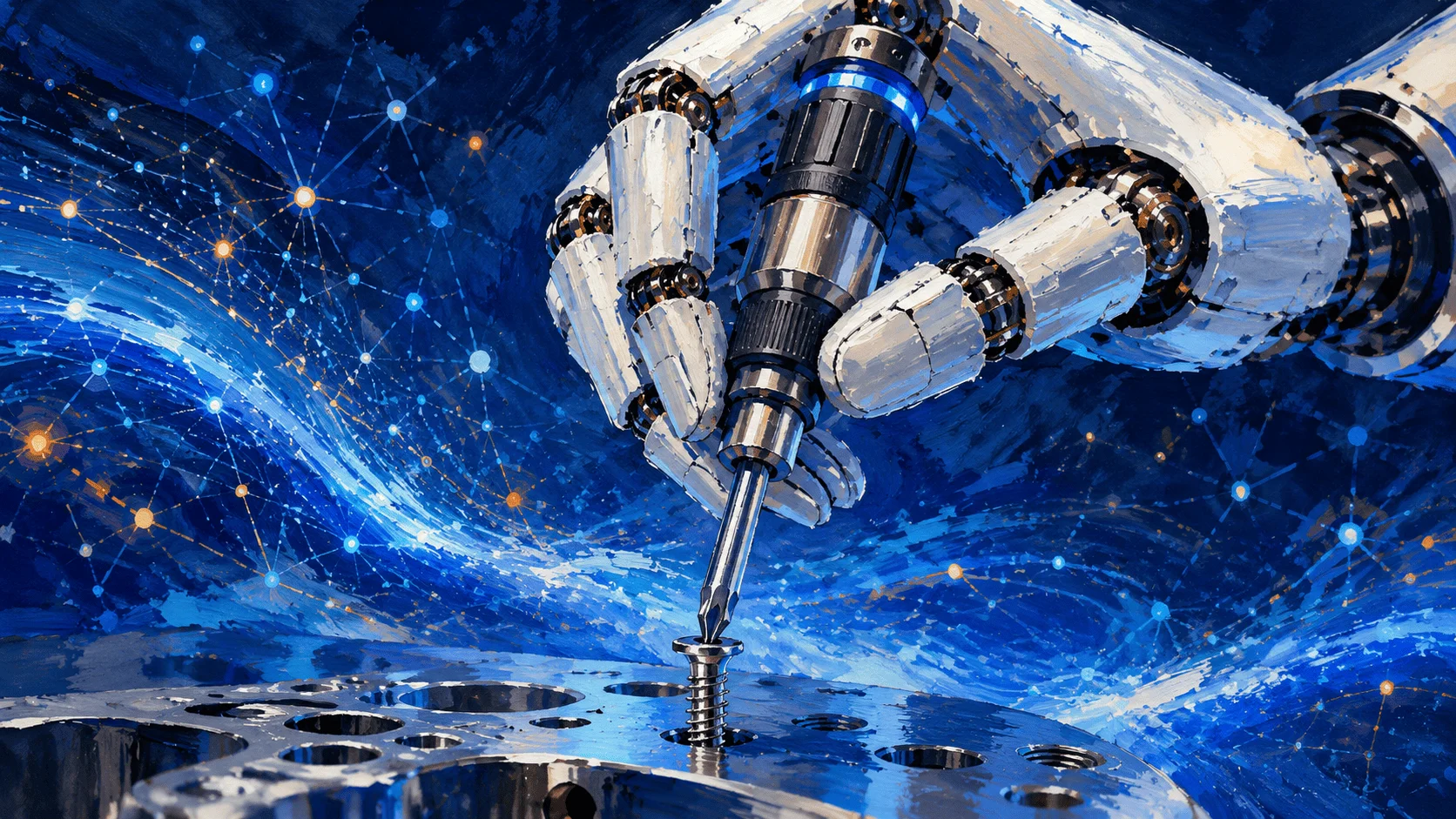
In a significant advance for robotics and artificial intelligence, researchers at the Korea Advanced Institute of Science and Technology (KAIST) have developed a new robot learning system that can generate highly precise movements even when trained on coarse, imprecise, or sparsely sampled human demonstrations.
The breakthrough technology, called DiSPo, promises to dramatically lower the barrier to teaching robots complex tasks by removing the need for expensive, high-precision demonstration data.
What is DiSPo?
DiSPo (Diffusion-SSM based Policy Learning for Coarse-to-Fine Action Discretization) is a multi-granularity manipulation model developed by Professor Daehyung Park’s team in KAIST’s School of Computing.
Unlike conventional imitation learning methods — such as Behavior Transformer or standard Diffusion Policy — which typically require dense, high-frequency demonstrations recorded at very short time intervals, DiSPo can extract fine-grained, accurate robot actions from rough, low-frequency human demonstrations.
The system autonomously adjusts the level of precision according to the demands of the specific task, without requiring additional retraining.
How DiSPo Works
The technology combines two powerful AI components:
- Mamba, a state-space model effective at predicting time intervals.
- Diffusion models, which excel at generating rich, detailed action representations.
A key innovation is the Step-scale factor mechanism. This allows users to directly control the time granularity during inference. Even when trained only on coarse demonstration data, DiSPo uses a discretization process to subdivide actions on the fly, producing smooth, high-precision motions.
“This study demonstrates that robots can learn precise motions from coarse demonstrations and autonomously adjust their level of precision according to the task situation,” said Professor Daehyung Park.
Impressive Performance Results
DiSPo has shown strong results in both simulation and real-world tests:
- In simulation benchmarks, it achieved up to 81% higher task success rates compared to state-of-the-art models.
- In real-world experiments using a collaborative robot arm, DiSPo successfully performed highly precise tasks such as:
- Passing a clamp through a narrow gap with only 2.5 mm radial clearance.
- Accurately pressing a small shutter button on a smartphone.
In these challenging scenarios, DiSPo delivered performance up to four times higher than existing AI models.
The research, with master’s student Nayoung Oh as first author, was presented on June 1, 2026, at the IEEE International Conference on Robotics and Automation (ICRA 2026) in Vienna, Austria.
Why This Matters
Traditional robot programming through demonstration has been limited by the high cost and effort required to collect precise, high-frequency data. Human demonstrators often move in a natural, somewhat “rough” manner, making it difficult for robots to replicate delicate operations.
DiSPo solves this fundamental problem. By enabling robots to learn from imperfect demonstrations and then refine their actions autonomously, the technology:
- Significantly reduces data collection costs and time.
- Makes advanced robot learning more accessible to non-experts.
- Improves adaptability — the robot can choose the right level of precision for each situation.
Potential Applications
The technology has broad implications across industries that require high dexterity and precision:
- Precision assembly and component manufacturing
- Medical and surgical robotics
- Cable connection and delicate electronics work
- Precision machining and quality inspection
- Service and household robots performing fine-motor tasks
Professor Park noted that DiSPo is expected to serve as a general-purpose robot learning technology for various industrial fields.
A Step Toward More Practical Human-Robot Collaboration
This development aligns with broader trends in robotics toward making AI systems more robust to real-world human input. Instead of forcing humans to demonstrate tasks like robots, DiSPo allows robots to understand and improve upon natural human demonstrations.
As robot deployment expands into factories, hospitals, and homes, technologies like DiSPo that bridge the gap between human teaching and machine precision will be increasingly valuable.
Sources: Official KAIST announcement (June 24, 2026), EurekAlert press release, ICRA 2026 paper presentation.
Stay updated with the latest breakthroughs in robotics, AI, and advanced technology from around the world.
Follow us on X @realnewshubs and subscribe for push notifications to receive real-time updates and in-depth coverage.