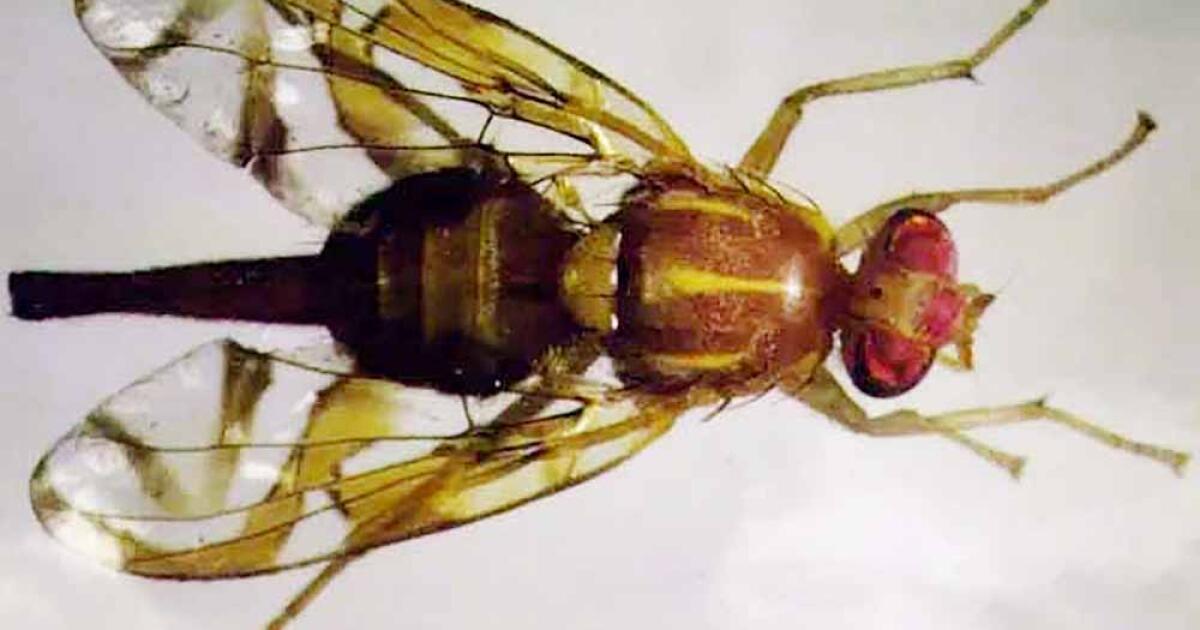
The California Department of Food and Agriculture (CDFA), alongside the USDA, recently expanded an emergency quarantine in San Diego County following new detections of the invasive Mexican fruit fly (Anastrepha ludens) in El Cajon and Spring Valley.
To combat the infestation before it destroys local crops, officials are deploying a biological control method known as the Sterile Insect Technique (SIT).
The “Fly Drop” Strategy
Over the coming months, specialized state aircraft will release up to 250,000 sterile male Mexican fruit flies per square mile each week across an area spanning up to 50 square miles.
- How it works: These laboratory-reared male flies are sterilized and marked with a special purple dye. When released into the wild, they outcompete fertile wild males to mate with wild females.
- The Result: Because the matings produce infertile eggs, the local breeding cycle collapses, naturally crashing the invasive population without relying heavily on widespread pesticide spraying.
The emergency program and aerial releases are scheduled to run through December 2026 to ensure they disrupt the pest across three full life cycles.
Why the Urgency?
The Mexican fruit fly is a massive threat to California’s multibillion-dollar agricultural sector and backyard gardens alike.
- Targeting 50+ Crops: The fly infests over 50 types of fruits and vegetables, with a particular fondness for citrus, avocados, and mangoes.
- How They Destroy Produce: Adult females use a tube-like organ to inject eggs directly beneath a fruit’s skin. Once the larvae (maggots) hatch, they tunnel through and feed on the pulp from the inside out, causing the fruit to rot and drop prematurely.
What the Quarantine Means for Residents
The official quarantine zone has expanded to cover roughly 111 square miles across East County, overlapping portions of El Cajon, La Mesa, Lemon Grove, San Diego, and Santee.
If you live within these boundaries, agricultural officials ask that you take specific precautions:
- Consume on-site: Home gardeners are strictly urged to eat all homegrown produce on their own properties. Do not share, mail, or move fruit off your property to prevent accidentally transporting larvae to unaffected regions.
- Proper disposal: If you have excess fruit you aren’t eating, do not throw it into green waste or compost. Instead, double-bag it in plastic and place it in your standard trash bin.
- Organic spot treatments: Properties within 200 meters of a confirmed fly detection may receive localized, ground-applied organic spot treatments using Spinosad (a naturally derived pesticide) to target adult flies.
Most suburban infestations start when travelers accidentally “hitchhike” pests into the state by bringing back undeclared fruit from international trips. If you live in the area and spot fruit that appears to be infested with larvae, you can report it directly to the state’s toll-free Pest Hotline at 1-800-491-1899.
Mexican fruit fly quarantine expands in San Diego County features a local news broadcast mapping out the exact boundaries of the quarantine and what residents need to do with their backyard fruit trees.