




Price:
(as of – Details)

This book focuses on the role of US and European churches, academics, think tanks, foundations, government and human rights groups in fostering the separation of the identities of Dravidian and Dalit communities from the rest of India. The book is the result of five years of research, and uses information obtained in the West about foreign funding of these India-based activities. The research tracked the money trails that start out claiming to be for ‘education’, ‘human rights’, ‘empowerment training’, and ‘leadership training’, but end up in programs designed to produce angry youths who feel disenfranchised from Indian identity. The book reveals how outdated racial theories continue to provide academic frameworks and fuel the rhetoric that can trigger civil wars and genocides in developing countries. The Dravidian movement’s 200-year history has such origins. Its latest manifestation is the ‘Dravidian Christianity’ movement that fabricates a political and cultural history to exploit old faultlines. This book explicitly names individuals and institutions, including prominent Western ones and their Indian affiliates. Its goal is to spark an honest debate on the extent to which human rights and other ‘empowerment’ projects are cover-ups for these nefarious activities.
From the Publisher
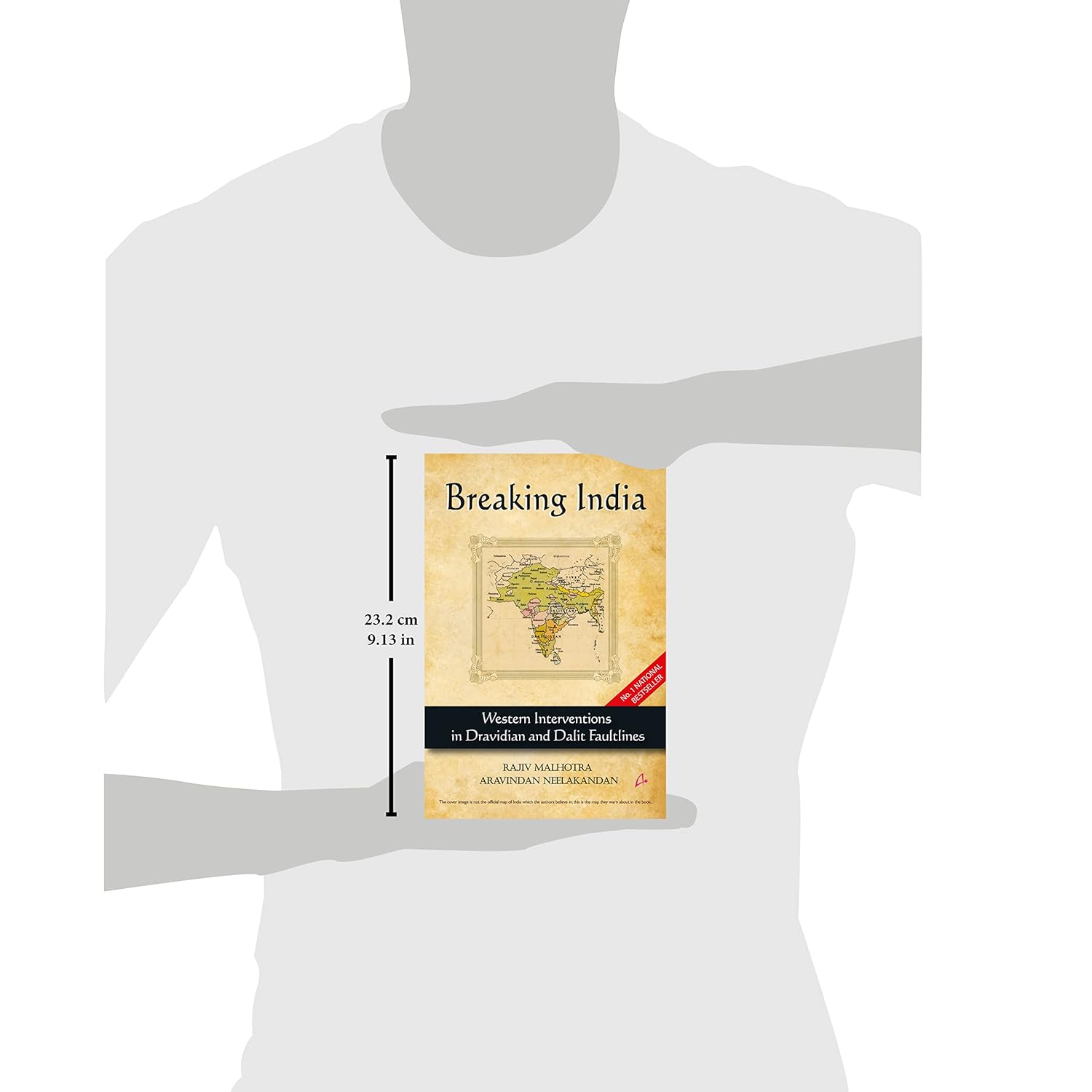
Breaking India: Western Interventions In Dravidian And Dalit Faultlines


Publisher : Amaryllis – an Imprint of Manjul Publishing House (1 February 2011)
Language : English
Hardcover : 640 pages
ISBN-10 : 8191067374
ISBN-13 : 978-8191067378
Item Weight : 1 kg 50 g
Dimensions : 22 x 14 x 1.5 cm
Country of Origin : India
Net Quantity : 1.00 Kilograms
Best Sellers Rank: #8,564 in Books (See Top 100 in Books) #22 in International Relations & Globalization #76 in Indian History (Books) #84 in Asian History (Books)
Customer Reviews: 4.7 4.7 out of 5 stars 1,477 ratings var dpAcrHasRegisteredArcLinkClickAction; P.when(‘A’, ‘ready’).execute(function(A) { if (dpAcrHasRegisteredArcLinkClickAction !== true) { dpAcrHasRegisteredArcLinkClickAction = true; A.declarative( ‘acrLink-click-metrics’, ‘click’, { “allowLinkDefault”: true }, function (event) { if (window.ue) { ue.count(“acrLinkClickCount”, (ue.count(“acrLinkClickCount”) || 0) + 1); } } ); } }); P.when(‘A’, ‘cf’).execute(function(A) { A.declarative(‘acrStarsLink-click-metrics’, ‘click’, { “allowLinkDefault” : true }, function(event){ if(window.ue) { ue.count(“acrStarsLinkWithPopoverClickCount”, (ue.count(“acrStarsLinkWithPopoverClickCount”) || 0) + 1); } }); });
Customers say
Customers find this book well-researched and informative, with one review noting its detailed analysis from the 15th century. Moreover, they appreciate its authenticity, with one customer describing it as the most unbiased representation of Indian historical events. The writing style is lucid, and customers consider it a must-read for every Indian, with one review highlighting how it changes one’s outlook towards their own country.