
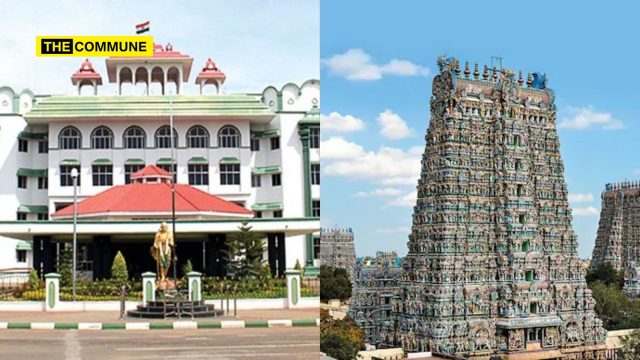
August 28, 2025, CHENNAI – In a landmark ruling that has ignited fierce debates over the intersection of religion, state control, and public welfare, the Madras High Court has prohibited the Tamil Nadu government from utilizing funds from Hindu temples to construct or maintain marriage halls. The decision, delivered by a division bench comprising Justices S.M. Subramaniam and C. Kumarappan on August 27, 2025, underscores the principle of religious autonomy and has drawn sharp reactions from political leaders, religious organizations, and civil society groups. Critics hail it as a victory for temple sovereignty, while supporters of the government’s initiatives decry it as a setback for community development.
The Ruling: A Clampdown on State Interference
The case stemmed from a public interest litigation (PIL) filed by advocate T. S. Sundar, who argued that diverting temple revenues—derived from donations, offerings, and land endowments—violated the autonomy of Hindu religious institutions under Article 26 of the Indian Constitution, which guarantees the right to manage religious affairs. The petitioner contended that temples like the Sri Ranganathaswamy Temple in Srirangam and others under the Hindu Religious and Charitable Endowments (HR&CE) Department were being stripped of resources meant for rituals, maintenance, and spiritual activities to fund secular projects such as kalyana mandapams (marriage halls).
The court, in its 45-page order, ruled that “temple funds are sacred and must be used exclusively for the propagation and preservation of Hindu religious practices.” Justices Subramaniam and Kumarappan emphasized that while the state has a role in regulating temple administration to prevent mismanagement, it cannot repurpose funds for non-religious purposes without explicit legislative sanction. “The HR&CE Department’s actions amount to an overreach, diluting the essence of religious endowments,” the bench stated, directing the government to refund any previously diverted amounts and submit a compliance report within three months.
This isn’t the first such intervention by the Madras High Court. In recent years, it has repeatedly curbed similar diversions, including a 2023 order restricting the use of temple gold for non-religious purposes and a 2024 directive against commercial exploitation of temple lands. The latest ruling builds on these precedents, potentially affecting over 38,000 temples managed by the HR&CE Department, which collectively generate annual revenues exceeding ₹1,500 crore (about $180 million).
Background: The Government’s Marriage Hall Initiative
The controversy traces back to the Tamil Nadu government’s ambitious scheme launched in 2022 under Chief Minister M.K. Stalin’s Dravida Munnetra Kazhagam (DMK) administration. Aimed at providing affordable venues for weddings in rural and semi-urban areas, the program sought to build or renovate 1,000 marriage halls using temple funds, citing the cultural importance of community gatherings. Proponents argued that these halls would benefit devotees, especially from economically disadvantaged backgrounds, by offering subsidized rates for events tied to religious festivals.
However, the initiative faced backlash from Hindu groups like the Bharatiya Janata Party (BJP) and Vishva Hindu Parishad (VHP), who accused the DMK—a historically anti-Hindu, rationalist party—of exploiting temples for political gains. Data from the HR&CE Department revealed that between 2022 and 2025, approximately ₹250 crore had been allocated from temple coffers for such projects, prompting the PIL. “Temples are not the state’s ATM,” Sundar argued in court, echoing sentiments from seers of major temples who claimed the diversions had led to neglected maintenance and reduced priest salaries.
The government’s defense rested on the Tamil Nadu Hindu Religious and Charitable Endowments Act, 1959, which empowers the state to oversee temple finances for public benefit. HR&CE Minister P.K. Sekar Babu, in a post-ruling statement, lamented the decision as “short-sighted,” asserting that marriage halls foster social harmony and indirectly support temple activities by hosting religious events.
Sparks Fly: Debate on Religious Autonomy vs. State Welfare
The ruling has polarized opinions, thrusting the issue of religious autonomy into the national spotlight amid rising tensions over secularism in India. Supporters, including BJP leaders, celebrated it as a “historic affirmation of Hindu rights.” Union Minister for Culture Gajendra Singh Shekhawat tweeted: “The Madras HC has rightly protected our temples from misuse. This is a win for Sanatan Dharma against pseudo-secularism.” The RSS-affiliated Hindu organizations have called for nationwide audits of temple funds, drawing parallels to similar disputes in Andhra Pradesh and Karnataka.
On the other hand, DMK allies and progressive voices decried the judgment as elitist and disconnected from ground realities. CPI(M) leader Brinda Karat argued in an op-ed for The Hindu that “denying temples’ role in community welfare ignores their historical function as social hubs.” Women’s rights activists highlighted how marriage halls empower marginalized castes by providing accessible spaces for inter-caste weddings, potentially curbing honor killings. A survey by the Centre for Policy Studies in Chennai found 62% of respondents supporting the government’s use of funds for public good, versus 38% favoring strict religious exclusivity.
Legal experts are divided. Constitutional scholar M. Siddharth noted that the ruling reinforces the Supreme Court’s 2019 Sabarimala verdict principles, limiting state intervention in core religious matters. However, others like advocate Aparna Bhat warn of implementation challenges, predicting appeals to the Supreme Court and possible legislative amendments by the Tamil Nadu assembly.
Social media has amplified the debate, with #TempleFunds trending on X (formerly Twitter). Hashtags like #SaveOurTemples garnered over 500,000 posts in support of the ruling, while #MarriageHallsForAll saw counter-campaigns from DMK supporters. Influential voices, including actor and BJP MP Khushbu Sundar, urged devotees to donate directly to temples, bypassing government channels.
| Key Arguments For the Ruling | Key Arguments Against the Ruling |
|---|---|
| Protects religious autonomy under Article 26 | Marriage halls serve devotees and promote social equity |
| Prevents misuse of sacred funds for secular gains | Temples historically fund community welfare projects |
| Ensures transparency in temple administration | Could hinder rural development in a state with high poverty rates |
| Aligns with Supreme Court precedents on endowments | Risks politicization of religious institutions |
Implications: A Broader Challenge to State-Temple Relations
This decision could reshape temple governance across India, where state control over Hindu institutions has long been contentious. In Tamil Nadu, home to some of the world’s richest temples like Tirupati (though in Andhra Pradesh, similar issues persist), it may force the government to seek alternative funding for social schemes, potentially through increased taxes or private partnerships. Economically, it might boost direct donations to temples, with early reports of a 15% spike in online contributions post-ruling.
Politically, the verdict emboldens the opposition BJP ahead of the 2026 assembly elections, where temple politics could play a pivotal role. For the DMK, it’s a PR setback, especially after accusations of anti-Hindu bias. As Justice Subramaniam remarked in the order: “The soul of a temple lies in its devotion, not in brick and mortar for hire.”
As appeals loom and the debate rages, this ruling serves as a stark reminder of the delicate balance between faith and governance in secular India. Devotees and policymakers alike await the next chapter in this unfolding saga.
Sources: The Hindu, Times of India, Indian Express, Deccan Chronicle, LiveLaw, Bar & Bench, ANI, and social media analyses.