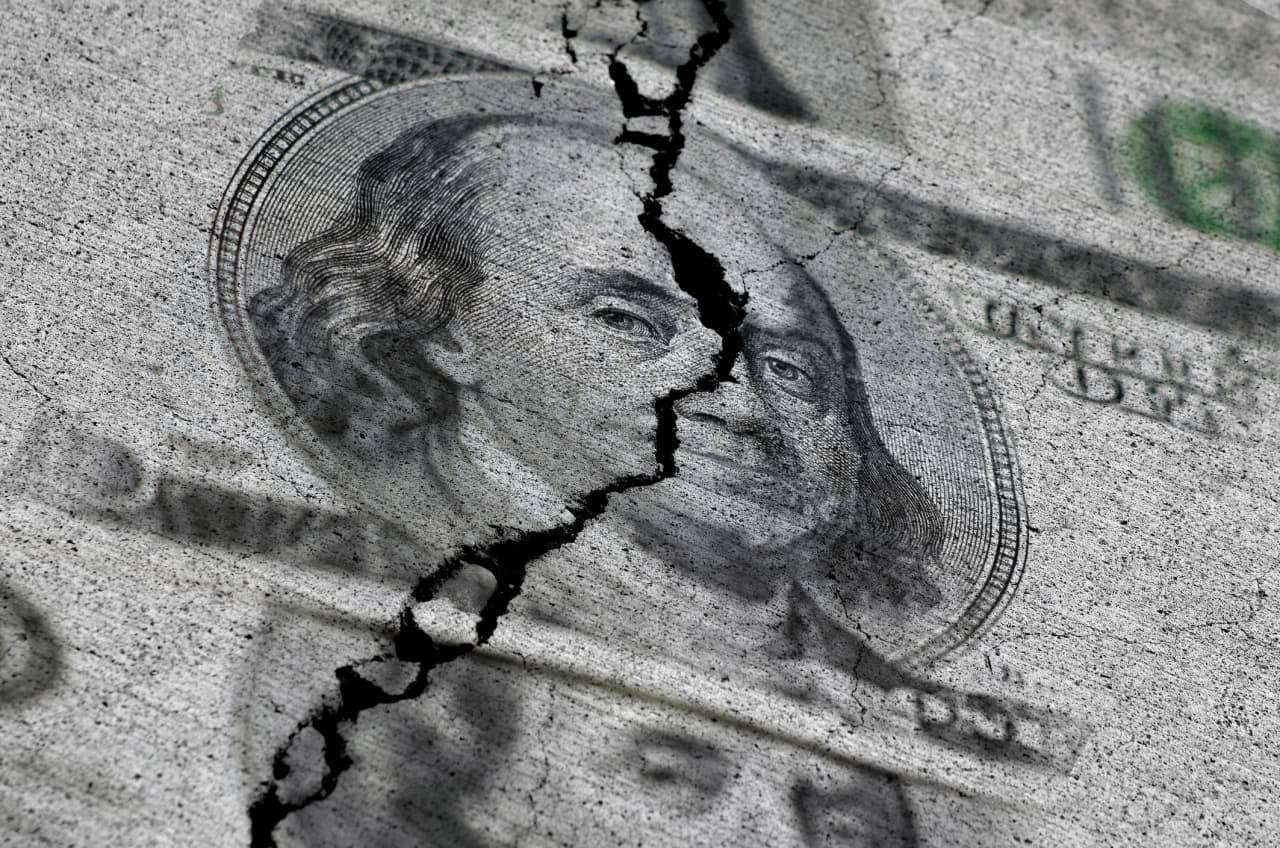
Private-Credit Crisis or Growing Pains? Why the ‘Big Six’ Banks Are a Safer Bet
As private credit markets swell past $1.7 trillion in assets, warnings of a looming “train wreck” are growing louder—but America’s largest banks are quietly positioning themselves as the safe harbor for investors nervous about unregulated lending, opaque balance sheets, and the first major test of this shadow banking boom.
The private-credit industry has exploded over the past decade, filling a gap left by traditional banks after post-2008 regulations made corporate lending more expensive and cumbersome. But with default rates creeping upward and regulators sharpening their scrutiny, investors are asking a critical question: Is this a temporary correction or the beginning of a systemic crisis?
The Private-Credit Boom by the Numbers
Private credit—non-bank lending provided by specialized funds, direct lenders, and insurance companies—has grown from roughly $250 billion in assets under management in 2010 to over $1.7 trillion today, according to Preqin. These loans typically go to mid-sized companies that cannot easily access public bond markets or prefer the flexibility of negotiated terms.
The appeal is obvious for borrowers: faster execution, customized covenants, and relationships with lenders who understand their business. For investors, private credit offers yield premiums of 400 to 600 basis points over comparable public debt—an irresistible spread in a low-yield environment.
But the very features that make private credit attractive also create risks. Loans are illiquid, valuations are often mark-to-model rather than mark-to-market, and leverage within the funds themselves can amplify losses. Unlike banks, private-credit funds face no capital adequacy requirements, no stress testing, and no direct Federal Reserve oversight.
Warning Signs Accumulate
Several indicators suggest the private-credit market is under genuine stress. Default rates among lower-middle-market borrowers have risen to 5.8% as of Q4 2025, up from 3.2% two years ago, according to Moody’s. Interest coverage ratios—a measure of a company’s ability to pay interest on its debt—have fallen to 1.8x, the lowest level since 2009.
The Federal Reserve has taken notice. In its March 2026 Financial Stability Report, the Federal Reserve warned that “valuation pressures in private credit markets are elevated” and that “interconnectedness with regulated entities could amplify shocks.” The FDIC has also signaled it is reviewing bank exposure to private-credit funds, while the Treasury Department has convened a working group on shadow banking risks.
Perhaps most tellingly, the SEC under Chair Gary Gensler has proposed new rules requiring private-credit funds to provide quarterly liquidity disclosures and to conduct annual stress tests. The industry has pushed back hard, arguing that regulation would destroy the flexibility that makes private credit valuable. Bank of America analysts recently noted that the fight over SEC rules “will define the next five years of private markets.”
The Big Six Advantage
While private credit faces headwinds, America’s six largest banks—JPMorgan Chase, Bank of America, Citigroup, Wells Fargo, Goldman Sachs, and Morgan Stanley—offer a compelling alternative for risk-aware investors.
First, JPMorgan Chase, Bank of America, and their peers operate under a comprehensive regulatory framework designed to prevent exactly the kind of crisis that shadow banking might trigger. The Federal Reserve requires these institutions to maintain Common Equity Tier 1 capital ratios above 11%, to undergo annual Comprehensive Capital Analysis and Review (CCAR) stress tests, and to maintain liquidity coverage ratios that ensure they can survive a 30-day market freeze.
Second, the big banks have diversified revenue streams. When corporate lending slows, they earn fees from investment banking, asset management, and trading. When interest rates rise, their deposit franchises become more profitable. Private-credit funds, by contrast, live or die by the performance of their loan books.
Third, the banks are adapting rather than retreating. Goldman Sachs has built a $300 billion private-credit platform within its asset management division, but it structures those funds to keep risk off the bank’s balance sheet. Morgan Stanley has taken a similar approach, raising dedicated private-credit funds while maintaining stringent underwriting standards. Citigroup and Wells Fargo have partnered with private-credit managers to offer clients access without taking direct origination risk.
“The banks learned the hard way in 2008 what happens when you take too much risk off-balance-sheet,” said Sheila Bair, former FDIC chair, in a recent interview. “Now the private-credit funds are learning the same lesson. The difference is the banks have capital buffers and the Fed watching them. The funds have neither.”
Growing Pains or Systemic Crisis?
The private-credit industry argues that comparisons to 2008 are wildly overblown. Unlike subprime mortgages, private-credit loans are primarily to businesses, not consumers. Unlike collateralized debt obligations, most private-credit funds use modest leverage. And unlike the shadow banking system of the 2000s, today’s private lenders have longer-duration liabilities that reduce the risk of a run.
“What we’re seeing is not a crisis but a maturation,” said Michael Arougheti, CEO of Ares Management, one of the largest private-credit managers. “Every new asset class goes through a cycle of rapid growth, regulatory attention, and consolidation. That’s where we are now.”
The numbers support both views. On one hand, the private-credit default rate remains well below the 10% level seen in the high-yield bond market during the 2008 crisis. Recoveries on defaulted loans have averaged 68%, strong by historical standards. And most funds continue to pay distributions without interruption.
On the other hand, the Treasury Department’s Office of Financial Research has flagged that data gaps make it impossible to know the true risk. Unlike banks, private-credit funds do not report loan-level performance data to any central repository. When the next downturn comes, regulators may be flying blind.
What This Means for U.S. Investors
For individual investors, the private-credit question is ultimately about risk tolerance and time horizon. Direct investments in private-credit funds typically require lock-up periods of three to seven years and minimum investments of $250,000 or more. Those who can afford to wait out a downturn may capture the yield premium. Those who need liquidity should look elsewhere.
The FDIC insurance on bank deposits—up to $250,000 per depositor—does not apply to private-credit investments. If a fund fails, investors stand to lose their entire principal. Bank deposits, by contrast, are the safest asset in the financial system.
For retirement accounts and conservative portfolios, the big six banks offer a simpler proposition. Bank of America and JPMorgan Chase shares currently yield 3.2% and 2.8% respectively, with dividends that have grown annually for over a decade. More importantly, these banks have passed every stress test since 2011, including scenarios far worse than any plausible private-credit downturn.
The Bottom Line
Private credit is not about to collapse. The industry has genuine economic value, and most funds are professionally managed by firms with decades of experience. But the rapid growth, rising defaults, and regulatory blind spots mean that the next few years will separate the well-managed funds from the rest.
For investors who want exposure to corporate lending without the liquidity and regulatory risks of private credit, America’s largest banks offer a time-tested alternative. They are safer, more transparent, and backed by the full apparatus of federal supervision. In an uncertain market, that counts for something.
The Federal Reserve, SEC, FDIC, and Treasury Department will continue to monitor private-credit risks closely. But for now, the big six banks remain the gold standard for safety, liquidity, and regulatory oversight—advantages that look increasingly valuable as the private-credit boom enters its first major stress test.
Follow and subscribe for push notifications on the latest financial news, market analysis, and investment insights.
Writer: Sam Michael