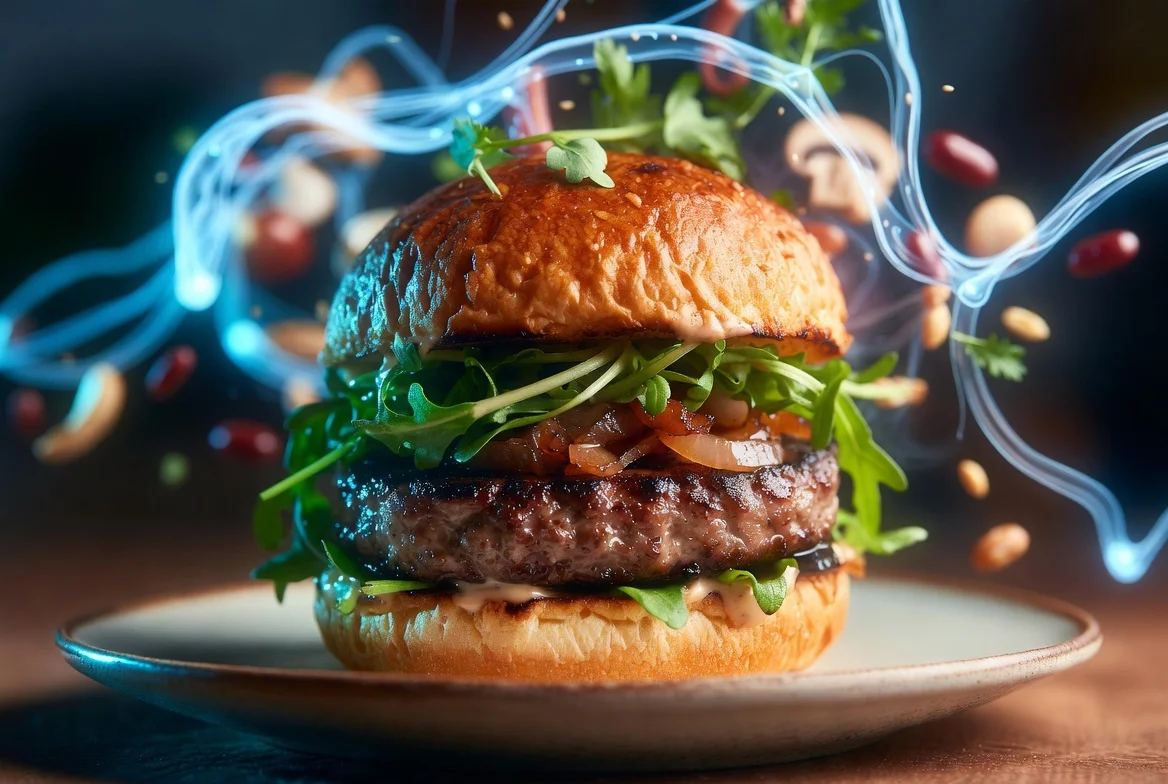
Researchers at Stanford University have developed a generative AI system that designs brand-new burger recipes optimized for great taste, improved nutrition, and dramatically lower environmental impact. In blind taste tests, some of the AI-created burgers performed as well as or better than a classic Big Mac, while other versions offered significantly better nutrition or a much smaller carbon footprint.
The project, called BurgerAI, uses the same type of diffusion-based generative models behind tools like image generators. Instead of creating pictures, however, it creates complete burger recipes from scratch.
How BurgerAI Works
The team trained the AI on more than 2,200 real burger recipes scraped from Food.com. The model learned patterns in ingredient combinations, quantities, and cooking methods. It then generated one million new recipe ideas and filtered them based on specific goals: maximum deliciousness, lowest environmental impact, or highest nutritional quality (measured by the Healthy Eating Index).
One of the most surprising findings was that the AI independently rediscovered the statistical flavor profile of the McDonald’s Big Mac — without ever being shown the actual recipe.
The researchers then created specific burgers optimized for different priorities and tested them against a Big Mac in a real restaurant setting with 101 participants.
Taste Test Results
In the blinded sensory evaluation, the AI-designed “delicious” burgers scored the same as or higher than the Big Mac in overall liking, flavor, and texture. Participants could not reliably tell which burgers were created by AI and which were the fast-food classic.
Even more striking were the specialized versions:
- A mushroom-based burger optimized for sustainability had an environmental impact score more than ten times lower than the Big Mac.
- A bean-based burger optimized for nutrition achieved a Healthy Eating Index score of 63.12 — nearly double the Big Mac’s score of 33.71.
These results suggest that generative AI can move beyond simple prediction and into actual product design, balancing competing goals like taste, health, and sustainability in ways that are difficult for human recipe developers to optimize manually.
Why This Matters
The Stanford study highlights a growing capability in generative AI: the ability to design physical products — not just text or images — with multiple constraints in mind. Burgers served as an accessible model system because they are popular, data-rich, and involve clear trade-offs between flavor, nutrition, and environmental cost.
For American consumers and the food industry, the implications are significant. As demand grows for more sustainable and healthier food options, tools like BurgerAI could help companies develop new products faster and with better outcomes. The technology could also be applied to other foods, from plant-based alternatives to processed snacks and restaurant menu items.
The researchers noted that the AI doesn’t replace chefs or food scientists — it acts as a powerful creative and optimization tool that can explore millions of possibilities quickly.
Public Access and Future Potential
The team has made a version of BurgerAI publicly available at ai4burgers.com, allowing people to experiment with generating their own optimized burger recipes based on different priorities.
While the study focused on burgers as a proof of concept, the underlying approach could be expanded to many other food categories. As generative AI continues to improve, similar systems may help address larger challenges in the food system, including reducing greenhouse gas emissions from agriculture and improving public health through better-formulated everyday foods.
The peer-reviewed study was published in the journal npj Science of Food. It represents one of the clearest demonstrations yet of generative AI moving from the digital world into real-world product innovation with measurable benefits for taste, health, and the planet.
Follow us on X @realnewshubs and subscribe for push notifications