
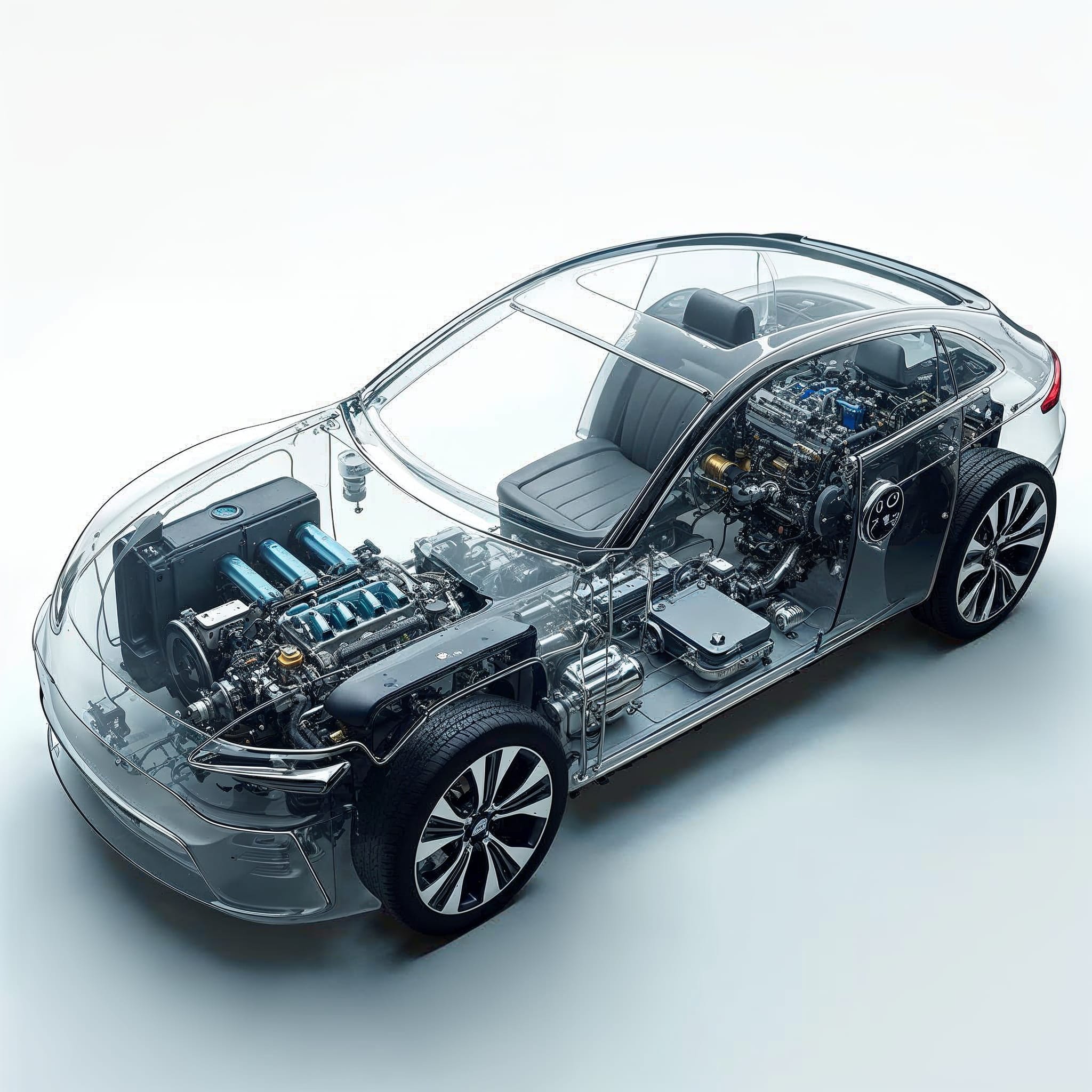
In the rapidly evolving landscape of automotive technology, hybrid vehicles have emerged as a crucial bridge between traditional internal combustion engine (ICE) cars and fully electric vehicles (EVs). They promise a blend of fuel efficiency, reduced emissions, and the convenience of a conventional refueling infrastructure. However, beneath the surface of what appears to be a simple combination of gasoline and electric power lies a complex world of engineering choices, primarily concerning the drivetrain architecture. The “drivetrain dilemma” for engineers and consumers alike often boils down to understanding the fundamental differences between series hybrid and parallel hybrid configurations, and the increasingly popular series-parallel (power-split) hybrid systems.
This comprehensive guide delves deep into the mechanics, advantages, disadvantages, and practical applications of these core hybrid architectures. We will explore how each system manages the interplay between the gasoline engine, electric motor, and battery, and how these choices impact a vehicle’s performance, efficiency, and driving characteristics. By the end, you will have a clear understanding of why different hybrid systems are chosen for different types of vehicles and driving scenarios, equipped with the knowledge to appreciate the engineering marvels that power our increasingly electrified roads.
Understanding Hybrid Vehicles: A Quick Refresher
Before we dissect the intricacies of series and parallel systems, let’s briefly revisit what defines a hybrid vehicle. At its core, a hybrid car combines at least two distinct power sources to propel the vehicle. In most common automotive applications, this refers to an internal combustion engine (ICE) and an electric motor, powered by a battery pack.
The primary goals of a hybrid system are:
- Improved Fuel Efficiency: By allowing the ICE to operate in its most efficient range or to shut off entirely when not needed (e.g., at a stop or during low-speed electric-only driving).
- Reduced Emissions: Less fuel consumption naturally leads to fewer tailpipe emissions.
- Enhanced Performance: The electric motor can provide instant torque for acceleration boost, complementing the ICE.
- Regenerative Braking: Recovering kinetic energy normally lost as heat during braking and converting it back into electricity to recharge the battery.
Key components typically found in a hybrid drivetrain include:
- Internal Combustion Engine (ICE): The traditional gasoline (or diesel) engine.
- Electric Motor/Generator (MG): Often referred to as motor-generators because they can both provide power to drive the wheels and generate electricity to charge the battery. Modern hybrids often use multiple MGs.
- Battery Pack: Stores electrical energy for the motor and for regeneration. Typically lithium-ion or nickel-metal hydride.
- Power Control Unit (PCU): The “brain” that manages the flow of power between the ICE, motor, generator, and battery, optimizing for efficiency or performance based on driving conditions.
- Transmission/Drivetrain: The mechanical link that transmits power to the wheels. This is where series and parallel systems diverge significantly.
The magic happens in how these components are connected and how their power is managed. This is where the concepts of series and parallel architectures become critical.
The Series Hybrid Architecture: Power Without Direct Mechanical Link
Imagine a powerful electric train. It runs on electricity, but that electricity might be generated by a diesel engine on board. This analogy perfectly describes a series hybrid system. In a series hybrid, the internal combustion engine never directly drives the wheels. Instead, its sole purpose is to act as a generator, producing electricity to power the electric motor(s) that drive the wheels, and/or to recharge the battery pack.
How Series Hybrids Work
The operational principle of a series hybrid is relatively straightforward:
- The ICE is mechanically coupled to an electric generator.
- The generator produces electricity, which can be sent to one of two places:
- Directly to the electric drive motor(s) that propel the vehicle.
- To the battery pack for storage.
- The electric drive motor(s) are the only components directly connected to the wheels.
- When the battery has sufficient charge, the vehicle can operate in pure electric mode (EV mode), with the ICE completely off.
- During heavy acceleration or when the battery is depleted, the ICE starts up to generate electricity, either assisting the battery in powering the motors or recharging the battery.
- Regenerative braking is highly effective, as the drive motor can easily switch to generator mode to recover energy.
Essentially, a series hybrid functions much like an electric vehicle with an onboard generator – often referred to as a Range-Extended Electric Vehicle (REEV) or Extended-Range Electric Vehicle (EREV). The ICE acts as a range extender, preventing “range anxiety” without directly powering the wheels.
Advantages of Series Hybrids
The unique configuration of series hybrids offers several distinct benefits:
- Simplicity of Control: Because the ICE is decoupled from the wheels, its operation can be optimized for fuel efficiency, running at a constant, optimal RPM to generate electricity. This simplifies engine control and reduces emissions.
- Excellent for Urban Driving: In stop-and-go traffic, the vehicle can often operate purely on electric power, leading to zero tailpipe emissions and silent operation. The ICE only kicks in when the battery needs charging or demands are high.
- Efficient Regenerative Braking: The electric motor is always driving the wheels, making it highly effective at capturing kinetic energy during deceleration and converting it back into electricity.
- Smoother Driving Experience: Without mechanical gears or direct engine connection, the power delivery is often smoother and more linear, similar to a pure EV. There are no traditional gear shifts to feel.
- Flexible Packaging: The ICE and generator can be placed almost anywhere in the vehicle, as they don’t need a direct mechanical link to the wheels, offering more design flexibility.
Disadvantages of Series Hybrids
Despite their advantages, series hybrids come with their own set of drawbacks:
- Double Energy Conversion Losses: This is the most significant disadvantage. Fuel energy is converted into mechanical energy (by the ICE), then into electrical energy (by the generator), then back into mechanical energy (by the electric motor) to drive the wheels. Each conversion incurs energy loss, making them less efficient at higher, sustained speeds compared to parallel systems.
- Larger/More Powerful Components: Since the electric motor is solely responsible for propelling the vehicle, it needs to be powerful enough to handle all driving conditions. Similarly, the generator must be robust enough to supply the necessary electricity. This often means larger, heavier, and more expensive electric components.
- Less Efficient at High Speeds: At sustained highway speeds, the double energy conversion becomes particularly inefficient. A direct mechanical link from the ICE to the wheels, as seen in parallel hybrids, is generally more efficient for high-speed cruising.
- Battery Reliance: A series hybrid is heavily reliant on its battery for power buffer and EV mode. A smaller battery might mean the ICE needs to run more frequently.
Typical Applications of Series Hybrids
Series hybrids are most commonly found in applications where their strengths are best utilized:
- Heavy-Duty Vehicles: Such as buses, trains, and some commercial trucks. These vehicles often operate in urban environments with frequent stops and starts, where the ICE can run optimally to generate electricity, and the high torque of electric motors is beneficial.
- Range-Extended Electric Vehicles (REEVs/EREVs): Cars like the BMW i3 REx or the Chevrolet Volt (Gen 1 & 2 operate as series hybrids in most conditions, but are technically series-parallel with a clutch for direct drive under specific high-speed scenarios) are prime examples. Their primary propulsion is electric, with the gasoline engine serving as a generator to extend range when the battery is depleted.
- Military Vehicles: Where efficiency, silent operation, and high torque for off-road conditions are critical.
The Parallel Hybrid Architecture: Blending Power Sources
In contrast to the series hybrid, the parallel hybrid architecture allows both the internal combustion engine and the electric motor to independently, or simultaneously, drive the wheels. They work “in parallel,” sharing the mechanical load. This configuration is the most common type found in mainstream passenger hybrid vehicles.
How Parallel Hybrids Work
The defining characteristic of a parallel hybrid is the mechanical connection between the ICE, the electric motor, and the wheels. This connection is typically managed through a specialized transmission or gearbox. Here’s how it generally operates:
- Both the ICE and the electric motor are connected to the vehicle’s drivetrain (e.g., through a conventional automatic transmission, a CVT, or a manual transmission).
- The vehicle can be propelled in several modes:
- Pure Electric (EV) Mode: At low speeds or during light acceleration, only the electric motor drives the wheels, with the ICE off.
- ICE-Only Mode: At higher speeds, especially highway cruising, the ICE can directly drive the wheels, often disengaging or assisting the electric motor.
- Combined (Hybrid) Mode: For maximum power (e.g., during hard acceleration), both the ICE and the electric motor work together to drive the wheels. The electric motor provides an instant torque boost.
- The electric motor also acts as a generator during regenerative braking, recharging the battery.
- When the battery needs charging, or during periods of light load, the ICE can simultaneously drive the wheels and power the electric motor (which then acts as a generator) to recharge the battery.
The key here is that the ICE has a direct mechanical path to the wheels, allowing it to be very efficient at certain speeds where direct drive is optimal.
Advantages of Parallel Hybrids
The parallel configuration offers a different set of advantages, particularly suited for diverse driving conditions:
- High Efficiency at Highway Speeds: Since the ICE can directly drive the wheels, there are no double energy conversion losses at cruising speeds, making parallel hybrids generally more efficient on the highway than series hybrids.
- Flexible Power Delivery: The ability to combine the power of both the ICE and electric motor provides excellent acceleration and responsiveness. The electric motor can “fill in” the torque gaps of the ICE at low RPMs.
- Smaller Electric Components: Often, the electric motor and battery can be smaller and lighter than those in a series hybrid because they do not have to handle the full propulsion load all the time; the ICE can assist.
- Lower Manufacturing Cost: Generally, parallel hybrid systems can be integrated with more conventional transmissions, potentially reducing complexity and cost compared to dedicated series hybrid powertrains or complex power-split systems.
- Better Performance Feel: Drivers accustomed to traditional ICE vehicles often find the driving dynamics of parallel hybrids more familiar, as the engine’s power delivery is directly felt.
Disadvantages of Parallel Hybrids
However, parallel hybrids also have their compromises:
- More Complex Control System: Orchestrating the seamless blending of power between the ICE and electric motor, and managing gear shifts, requires sophisticated electronic control units and software.
- Less Effective for Pure EV Driving: While they can operate in EV mode, the range is typically limited, and the system might activate the ICE more frequently due to the direct mechanical link. The EV mode might not be as robust or sustained as in a series hybrid.
- Packaging Challenges: Integrating the electric motor into an existing transmission or engine assembly can be challenging and may require significant redesigns.
- ICE Not Always Operating at Optimal RPM: Because the ICE is directly connected to the wheels and its speed varies with the vehicle’s speed (unless equipped with a CVT or planetary gearset), it may not always operate at its most fuel-efficient RPM, especially in city driving.
- Less Seamless Transitions: While highly refined, the engagement and disengagement of the ICE and electric motor, along with gear changes, can sometimes be less imperceptible than the pure electric drive of a series system.
Typical Applications of Parallel Hybrids
Parallel hybrids dominate the passenger car market due to their versatility and efficiency across a wide range of driving conditions:
- Compact and Mid-Size Sedans: Honda Civic Hybrid, Honda Insight, Hyundai Sonata Hybrid, Kia Optima Hybrid.
- SUVs and Crossovers: Many mild hybrid (MHEV) systems and some full hybrid (FHEV) systems use parallel configurations.
- Performance Hybrids: Where the electric motor primarily acts as a power boost for acceleration, complementing a powerful ICE.
The Series-Parallel (Complex/Power-Split) Hybrid: Best of Both Worlds?
Recognizing the strengths and weaknesses of both series and parallel architectures, engineers developed a third, more sophisticated type: the series-parallel hybrid, often referred to as a “power-split” hybrid. This system aims to combine the benefits of both worlds, offering high efficiency across a broader range of speeds and driving conditions.
How Series-Parallel Hybrids Work
The genius of the series-parallel hybrid lies in its use of a planetary gear set (often called an Electronic Continuously Variable Transmission, or eCVT, by some manufacturers, notably Toyota). This mechanical marvel allows for incredibly flexible power distribution:
- It typically uses two motor-generators (MG1 and MG2) in conjunction with the ICE, all connected to a planetary gear set.
- The planetary gear set acts as a power splitter, allowing the ICE to:
- Drive the wheels directly (like a parallel hybrid).
- Charge the battery by powering MG1 (like a series hybrid).
- Do both simultaneously.
- MG2 is typically the larger motor and primarily drives the wheels. MG1 is smaller and primarily acts as a generator or starter for the ICE.
- The system can operate in pure EV mode, ICE-only mode, or a combined mode. The unique aspect is its ability to constantly vary the ratio of power split between mechanical and electrical paths, effectively acting as an infinitely variable transmission.
- During regenerative braking, both MGs can contribute to energy recovery.
This configuration allows the system to operate the ICE at its most efficient RPM for a given power demand, independent of vehicle speed, much like a series hybrid, while also providing a direct mechanical link to the wheels for highway efficiency, like a parallel hybrid.
Advantages and Disadvantages of Series-Parallel Hybrids
Advantages:
- Optimal Efficiency: Offers the highest overall efficiency across a wide range of driving speeds and conditions by seamlessly switching between series and parallel operation modes.
- Smooth and Refined Operation: The eCVT provides an extremely smooth, gearless driving experience, similar to a series hybrid.
- Versatility: Can handle heavy loads, provide strong acceleration, and maintain good fuel economy in both city and highway driving.
- Robust and Reliable: While mechanically complex, systems like Toyota’s HSD have proven to be exceptionally reliable over decades.
- Strong Regenerative Braking: Effectively captures energy due to the constant electrical pathway.
Disadvantages:
- Mechanical Complexity: The planetary gear set and multiple motor-generators make this the most mechanically intricate and expensive hybrid architecture to design and manufacture.
- “Rubber Band” Effect: In some implementations, heavy acceleration can lead to the engine RPMs soaring without an immediate corresponding increase in vehicle speed, a sensation often described as the “rubber band” effect due to the eCVT nature.
- Higher Initial Cost: Due to the complexity and specialized components, these systems can be more expensive than simpler parallel hybrids.
Applications of Series-Parallel Hybrids
This architecture is incredibly popular and successful, particularly for its ability to deliver excellent fuel economy:
- Toyota and Lexus Hybrids: The vast majority of Toyota’s Hybrid Synergy Drive (HSD) and Lexus Hybrid Drive vehicles (e.g., Prius, Camry Hybrid, RAV4 Hybrid, Lexus RX 450h) utilize a series-parallel power-split system.
- Ford Hybrids: Ford’s hybrid vehicles (e.g., Ford Escape Hybrid, Ford Fusion Hybrid) also employ a similar power-split architecture licensed from Toyota.
- Hyundai/Kia’s Latest Hybrids: While many older Hyundai/Kia hybrids were parallel, newer, more advanced models are adopting power-split mechanisms.
Key Performance Metrics for Hybrid Drivetrains
When evaluating different hybrid architectures, several key performance metrics come into play, influencing everything from daily usability to long-term costs:
- Fuel Economy (MPG/L/100km): This is often the primary driver for choosing a hybrid. City vs. highway figures can vary significantly between architectures.
- Emissions: Reduced CO2, NOx, and particulate matter are critical benefits. EV-only range contributes to zero tailpipe emissions in urban areas.
- Acceleration and Power Delivery: How quickly and smoothly the vehicle responds to throttle input. Electric motors provide instant torque, which can mask turbo lag or improve overall responsiveness.
- EV Range: How far the vehicle can travel on electric power alone. This is particularly relevant for Plug-in Hybrid Electric Vehicles (PHEVs).
- Driving Feel: The sensation behind the wheel, including noise levels, vibration, and smoothness of power transitions.
- Cost: Initial purchase price, maintenance costs, and fuel savings over the vehicle’s lifetime.
- Reliability and Durability: The longevity and dependability of the complex hybrid components.
- Weight and Packaging: The impact of the hybrid components on the vehicle’s overall weight, interior space, and handling.
Recent Developments and Future Trends
The hybrid landscape is far from stagnant. Ongoing innovation continues to refine existing architectures and introduce new possibilities:
- Plug-in Hybrid Electric Vehicles (PHEVs): While not a distinct architecture, PHEVs can be built upon series, parallel, or series-parallel foundations. They feature larger battery packs and external charging capabilities, offering significantly extended EV-only range (often 30-60+ miles). This blurs the line between hybrids and EVs, offering daily electric commuting with the long-range flexibility of a gasoline engine. Many modern PHEVs are based on series-parallel systems (e.g., Toyota RAV4 Prime, Ford Escape PHEV) or advanced parallel designs.
- Advanced Battery Technology: Continued development in lithium-ion batteries is leading to higher energy density, faster charging times, longer lifespans, and lower costs. Solid-state batteries promise even greater leaps in the future, impacting the size and performance of hybrid battery packs.
- Sophisticated Control Algorithms: Artificial intelligence and machine learning are being integrated into hybrid control units. These systems can learn driving patterns, anticipate traffic conditions using navigation data, and optimize power flow for maximum efficiency in real-time, even predicting upcoming terrain (e.g., using GPS to know when to climb a hill and pre-charge the battery).
- Modular Hybrid Platforms: Manufacturers are developing scalable platforms that can accommodate various levels of electrification, from mild hybrids (MHEV) to full hybrids (FHEV) and PHEVs, allowing for greater production flexibility and cost reduction.
- Electrification of Transmissions: New transmission designs are incorporating electric motors directly into the gearbox, creating highly integrated and efficient parallel or series-parallel systems that are more compact and lighter.
- Focus on Lifecycle Emissions: Beyond tailpipe emissions, the automotive industry is increasingly focusing on the total lifecycle emissions of a vehicle, including manufacturing and end-of-life recycling. Hybrid technology plays a role in reducing overall carbon footprint.
- Enhanced Regenerative Braking: Advanced systems are improving the efficiency and feel of regenerative braking, often integrating it seamlessly with friction brakes for optimal energy recovery without driver discomfort.
These developments signify a continued evolution, with hybrid systems becoming ever more efficient, versatile, and integrated into the broader move towards electrification. The “dilemma” might become less about choosing one pure architecture and more about the optimal blend for specific use cases, powered by smarter electronics and more capable components.
Comparison Tables
| Feature | Series Hybrid | Parallel Hybrid | Series-Parallel (Power-Split) Hybrid |
|---|---|---|---|
| ICE Connection to Wheels | Indirect (via generator & motor) | Direct Mechanical Link | Variable (both direct and indirect paths) |
| Primary Drivetrain | Electric Motor | ICE (assisted by motor) | Blend of Electric Motor & ICE |
| Energy Conversion Loss | Higher (double conversion) | Lower (direct ICE drive) | Moderate (optimized blend) |
| Efficiency Profile | Best in city/low speed, less on highway | Good on highway/high speed, less in city | Excellent across all speeds/driving conditions |
| System Complexity | Relatively simple (engine & generator unit) | Moderate (motor integrated with transmission) | High (planetary gear set, multiple MGs) |
| EV Mode Capability | Strong & sustained (REEV capability) | Limited range & speed | Good, flexible range and speed |
| Driving Feel | EV-like, smooth, no gear shifts | More traditional, with engine noise/shifts | Very smooth, eCVT feel |
| Typical Applications | Buses, REEVs, heavy vehicles | Most mainstream passenger cars (mild/full hybrids) | Toyota/Lexus hybrids, many PHEVs |
| Component Size (Electric) | Larger motor/generator needed | Smaller motor/generator possible | Two motor-generators, optimized sizing |
| Manufacturing Cost | Moderate to High | Lower to Moderate | Highest |
| Driving Scenario | Series Hybrid Relative Efficiency | Parallel Hybrid Relative Efficiency | Series-Parallel Hybrid Relative Efficiency |
|---|---|---|---|
| Urban Stop-and-Go Traffic | 5 (High EV mode, optimal ICE RPM) | 3 (Frequent ICE activation, less pure EV) | 4 (Flexible EV mode, effective regeneration) |
| Sustained Highway Cruising | 2 (Double conversion losses significant) | 5 (Direct ICE drive, minimal conversion loss) | 4 (Efficient direct ICE drive with electric assist) |
| Moderate Acceleration | 4 (Instant electric torque) | 4 (Electric assist boosts ICE) | 5 (Optimized blend of ICE & electric) |
| Heavy Load/Uphill Driving | 3 (Requires powerful electric components) | 4 (ICE and motor combine power) | 5 (Highly effective power combination) |
| Regenerative Braking Effectiveness | 5 (Always electric drive, easy energy capture) | 3 (Can be less optimized, friction brakes more involved) | 5 (Excellent, seamless energy capture) |
| Cold Start Efficiency | 4 (ICE can warm up at optimal RPM) | 3 (ICE directly powers wheels while cold) | 4 (Flexible ICE operation to warm up efficiently) |
Practical Examples
To truly grasp the implications of these architectures, let’s look at some real-world examples and use cases.
Case Study 1: Series Hybrid in Urban Buses
Consider a large city bus. These vehicles spend their entire operational day in stop-and-go traffic, accelerating from bus stops, slowing down, and idling. Fuel efficiency in such conditions is paramount, as is the ability to operate quietly in residential areas. A series hybrid system is often the ideal choice here. The electric motors provide massive, instant torque needed to move a heavy bus from a standstill, and regenerative braking is highly effective at recovering the significant kinetic energy of a braking bus. The diesel engine can run at a constant, optimal RPM to generate electricity, ignoring the variable speed demands of the wheels, leading to better fuel economy and reduced emissions compared to a conventional diesel bus in city driving. This is why many municipal bus fleets around the world have adopted series hybrid technology.
Case Study 2: Parallel Hybrid in Passenger Cars (e.g., Honda Insight/CR-V Hybrid)
Many mainstream hybrid passenger cars, especially those from manufacturers like Honda, have historically leaned towards parallel hybrid systems. For example, older Honda Insights and newer CR-V Hybrids use configurations where the electric motor assists the gasoline engine directly. In a typical commute, the car might start in EV mode, transition to ICE-only on the highway, and combine both power sources for acceleration. This setup is excellent for drivers who experience a mix of city and highway driving. The ability to directly connect the ICE to the wheels makes it highly efficient for sustained highway cruising, which is a significant portion of many drivers’ commutes. The simpler mechanical layout, often integrated with a conventional transmission, can also contribute to a lower manufacturing cost, making these hybrids more accessible to the average consumer.
Case Study 3: Series-Parallel Hybrid in Popular Sedans (e.g., Toyota Prius/Camry Hybrid)
Toyota’s Hybrid Synergy Drive (HSD) system, a quintessential series-parallel architecture, is arguably the most successful hybrid system globally, powering millions of vehicles like the iconic Prius and the best-selling Camry Hybrid. These vehicles consistently deliver excellent fuel economy in a wide variety of driving conditions, from congested city streets to open highways. The sophisticated power-split device allows the system to seamlessly switch between purely electric drive, engine-only drive, or a combination of both, always striving to operate the ICE at its peak efficiency. For a family sedan or a compact commuter car, this versatility translates into real-world fuel savings and a smooth, quiet driving experience, making it a compelling choice for a vast segment of the market. The ability to launch silently in EV mode and then have the ICE seamlessly engage without a noticeable jolt is a hallmark of this design.
Frequently Asked Questions
Q: What is the fundamental difference between series and parallel hybrids?
A: The fundamental difference lies in how the internal combustion engine (ICE) connects to the wheels. In a series hybrid, the ICE never directly drives the wheels; it only generates electricity for an electric motor, which then drives the wheels. In a parallel hybrid, both the ICE and the electric motor can directly drive the wheels, either independently or together, via a mechanical connection.
Q: Which hybrid type is better for city driving?
A: Series hybrids and series-parallel hybrids generally excel in city driving. Series hybrids, particularly Range-Extended EVs, can operate predominantly in pure electric mode in stop-and-go traffic, offering zero emissions and high efficiency. Series-parallel systems (like Toyota’s) also manage city driving very efficiently by frequently using EV mode and optimizing the ICE’s operation.
Q: Which hybrid type is better for highway driving?
A: Parallel hybrids are typically more efficient for sustained highway driving. Because the ICE can directly drive the wheels, there are fewer energy conversion losses compared to a series hybrid, where electricity must be generated and then used by a motor. Series-parallel hybrids also perform very well on highways by utilizing their direct mechanical link when beneficial.
Q: Do series hybrids have a traditional transmission?
A: No, typically not in the conventional sense. Since the electric motor is the sole propulsion unit connected to the wheels, a multi-speed transmission is usually not required. The electric motor provides consistent torque across its RPM range. The ICE is connected to a generator, not directly to the drivetrain, so it also doesn’t need a transmission.
Q: Are plug-in hybrids (PHEVs) typically series or parallel?
A: PHEVs can be built on any of the architectures. Many modern PHEVs, especially those prioritizing extended EV range and overall efficiency, often leverage series-parallel (power-split) architectures (e.g., Toyota RAV4 Prime, Ford Escape PHEV). However, some also use advanced parallel systems (e.g., Hyundai Santa Fe PHEV) or, less commonly, series systems as a range extender.
Q: What is a “power-split” hybrid system?
A: A “power-split” system is another name for a series-parallel hybrid. It uses a planetary gear set (often referred to as an eCVT) to mechanically link the engine, two motor-generators, and the wheels. This allows it to dynamically split the engine’s power between driving the wheels and generating electricity, enabling it to act like both a series and a parallel hybrid as needed, optimizing efficiency across various driving conditions.
Q: Why are most mainstream passenger cars parallel hybrids or series-parallel hybrids?
A: Parallel hybrids offer a good balance of highway efficiency, power delivery, and relatively lower manufacturing complexity/cost compared to dedicated series systems. Series-parallel (power-split) hybrids like those from Toyota offer superior overall efficiency and versatility across diverse driving conditions, which is ideal for the varied needs of passenger car drivers, making them highly popular despite their mechanical complexity.
Q: Can a series hybrid operate with a dead battery?
A: Not entirely. While the ICE in a series hybrid can generate electricity to power the motor directly, the battery acts as a crucial buffer. If the battery is completely dead and cannot accept a charge or provide any supplemental power, the system might struggle to operate or enter a ‘limp home’ mode. The battery is integral to managing power surges and recovery, and a completely depleted battery would severely limit functionality. However, the ICE’s primary function is to keep the battery charged to a minimum operational level.
Q: What are the main advantages of a series-parallel hybrid?
A: The main advantages are its superior overall efficiency across a wide range of driving speeds and conditions, its smooth and refined operation due to the eCVT-like power delivery, and its versatility in handling various demands from pure EV mode to strong combined acceleration. It effectively combines the strengths of both series and parallel architectures.
Q: How do these architectures impact vehicle maintenance?
A: Generally, hybrid vehicles introduce new components (electric motors, battery, power electronics) that require specialized knowledge for repair, but they often have
Key Takeaways
Navigating the “Drivetrain Dilemma” reveals that there isn’t a single “best” hybrid architecture; rather, there’s an optimal choice for specific applications and driving conditions. Here are the main points to remember:
- Series Hybrids: Excel in urban, stop-and-go driving with strong EV mode capability and efficient regenerative braking. Best for heavy-duty vehicles or Range-Extended EVs. Suffer from double energy conversion losses at high speeds.
- Parallel Hybrids: Offer high efficiency at highway speeds due to the direct mechanical link between the ICE and wheels. Common in many mainstream passenger cars, providing a balance of performance and fuel economy across mixed driving. More complex control systems.
- Series-Parallel Hybrids (Power-Split): Aim to combine the best of both worlds, offering superior overall efficiency across diverse driving conditions. Achieved through a sophisticated planetary gear set (eCVT) allowing flexible power distribution. Widely adopted by Toyota/Lexus and others. Mechanically the most complex.
- Efficiency Trade-offs: Each architecture has inherent efficiency strengths and weaknesses depending on speed and load. Series systems are better for electric drive efficiency, parallel for direct ICE drive efficiency, and series-parallel for overall balanced efficiency.
- Recent Developments: PHEVs are expanding hybrid capabilities, while advanced battery tech, AI-driven control algorithms, and modular platforms are continuously refining hybrid systems, making them smarter and more efficient.
- Consumer Choice: Understanding these differences empowers consumers to make informed decisions based on their driving habits, environmental priorities, and budget.
Conclusion
The journey through the mechanics of series, parallel, and series-parallel hybrid architectures reveals a fascinating world of engineering ingenuity. Far from being a simple ‘either/or’ choice, the “Drivetrain Dilemma” represents a nuanced design challenge where engineers carefully select the optimal configuration to meet specific performance, efficiency, and cost targets for a given vehicle type and intended use. From the pure electric propulsion of a series hybrid city bus to the seamless power blending of a series-parallel family sedan, each system plays a vital role in the ongoing transition towards a more sustainable automotive future.
As hybrid technology continues to evolve, driven by advancements in battery chemistry, power electronics, and intelligent control systems, we can expect even more sophisticated and efficient solutions to emerge. The goal remains the same: to provide drivers with vehicles that offer the best possible balance of fuel economy, reduced emissions, and enjoyable performance, paving the way for a greener, more electrified world of mobility. Whether your next vehicle employs a series, parallel, or series-parallel system, understanding its underlying architecture allows for a deeper appreciation of the complex innovation powering the roads ahead.