
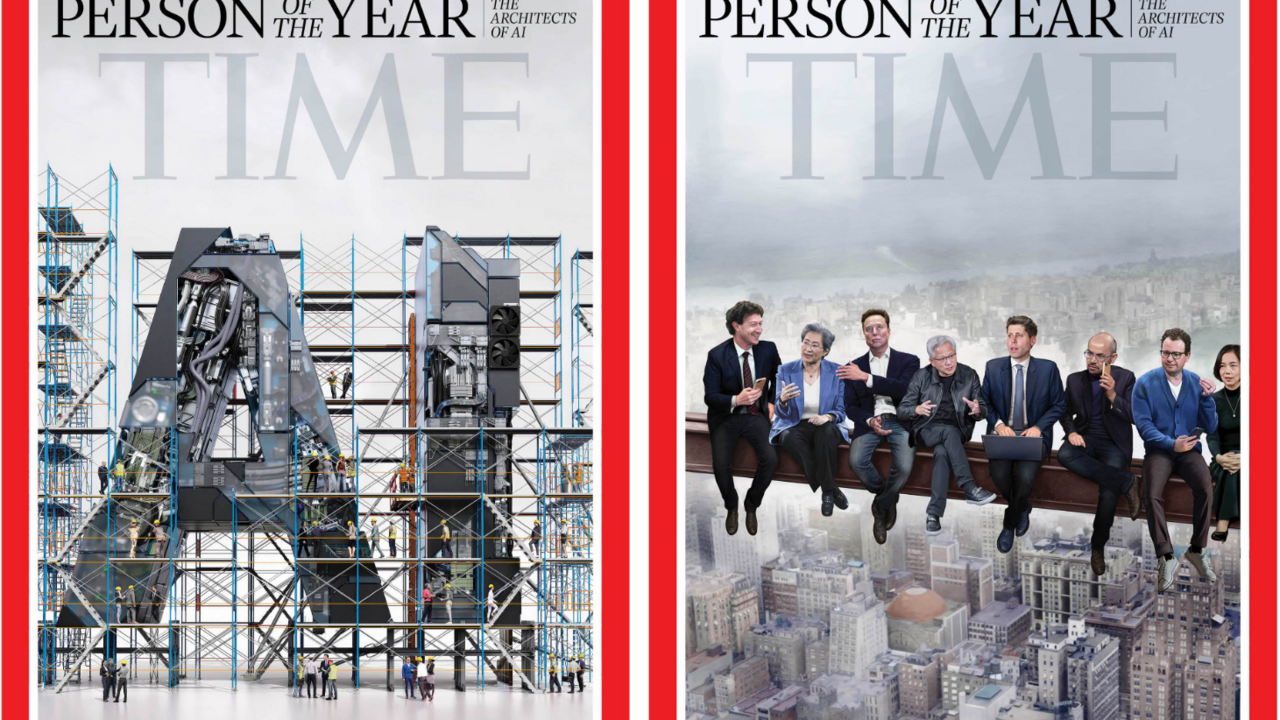
Time journal has named “The Architects of AI” as its Individual of the Yr for 2025, recognizing the collective affect of people and groups behind the transformative developments in synthetic intelligence. This resolution, introduced in December 2024, highlights the profound societal shifts pushed by AI applied sciences throughout varied international sectors.
Background: The Genesis and Evolution of AI
The idea of synthetic intelligence, as soon as confined to the realm of science fiction, has deep roots within the mid-Twentieth century. Visionaries started to ponder the potential for machines able to thought, studying, and problem-solving, laying the theoretical groundwork for what would develop into certainly one of humanity’s most impactful technological endeavors.
Early Visions and Theoretical Foundations
The mental genesis of AI is usually traced again to British mathematician Alan Turing. In his seminal 1950 paper, “Computing Equipment and Intelligence,” Turing proposed what would develop into referred to as the Turing Take a look at, a benchmark for machine intelligence. He questioned whether or not machines might exhibit clever habits indistinguishable from a human, sparking foundational debates about consciousness and computation. This era noticed theoretical breakthroughs however restricted sensible purposes attributable to nascent computing energy.
The formal start of AI as a area occurred on the Dartmouth Workshop in the summertime of 1956. Organized by John McCarthy, Marvin Minsky, Nathaniel Rochester, and Claude Shannon, this gathering introduced collectively main researchers who coined the time period “synthetic intelligence.” They posited that “each side of studying or another function of intelligence can in precept be so exactly described {that a} machine might be made to simulate it.” This optimistic outlook fueled preliminary analysis into symbolic AI, which targeted on representing information with symbols and guidelines.
Regardless of early enthusiasm, the sphere skilled durations referred to as “AI winters” within the Nineteen Seventies and late Eighties, marked by lowered funding and skepticism. The constraints of symbolic AI in dealing with real-world complexity and the dearth of ample computational assets hindered progress. Nevertheless, throughout these durations, elementary analysis continued, exploring different paradigms like connectionism, which sought to mannequin intelligence primarily based on neural networks impressed by the human mind.
The Rise of Machine Studying
The shift from symbolic AI to machine studying started to realize traction as researchers explored statistical strategies for enabling machines to be taught from information with out specific programming. Frank Rosenblatt’s Perceptron in 1957 was an early instance of a neural community able to studying patterns. Whereas initially promising, its limitations have been highlighted by Minsky and Papert in 1969, contributing to the primary AI winter.
A big breakthrough got here with the re-emergence of the backpropagation algorithm within the Eighties, notably popularized by David Rumelhart, Geoffrey Hinton, and Ronald Williams. This algorithm allowed multi-layered neural networks to be taught complicated relationships from information, offering a extra sturdy studying mechanism. Concurrently, different machine studying methods like Assist Vector Machines (SVMs) and resolution bushes additionally gained prominence, providing highly effective instruments for classification and regression duties.
The growing availability of digital information and enhancements in computational energy, significantly within the late Twentieth and early twenty first centuries, served as essential catalysts. Massive datasets turned accessible, and processors turned quick sufficient to coach extra complicated fashions, setting the stage for the subsequent revolution. Researchers started to grasp that intelligence wasn’t nearly guidelines but additionally about recognizing patterns in huge quantities of data.
Deep Studying Revolution
The true inflection level arrived with the deep studying revolution, a subfield of machine studying that makes use of neural networks with many layers (therefore “deep”). Geoffrey Hinton, also known as the “Godfather of AI,” alongside together with his college students and colleagues, made essential contributions to overcoming the vanishing gradient drawback and growing more practical coaching strategies for deep neural networks. His work on deep perception networks within the mid-2000s demonstrated the potential of unsupervised pre-training.
The turning level for public and scientific recognition of deep studying’s energy got here with the ImageNet Massive Scale Visible Recognition Problem (ILSVRC) in 2012. AlexNet, a convolutional neural community (CNN) developed by Alex Krizhevsky, Ilya Sutskever, and Geoffrey Hinton on the College of Toronto, dramatically outperformed all earlier entries, decreasing the error charge in picture classification by a big margin. This occasion catalyzed widespread adoption of CNNs in laptop imaginative and prescient, resulting in speedy developments in object recognition, facial recognition, and autonomous driving.
Past laptop imaginative and prescient, deep studying prolonged its attain. Recurrent Neural Networks (RNNs) and their extra subtle variant, Lengthy Quick-Time period Reminiscence (LSTM) networks, turned instrumental in processing sequential information, enabling breakthroughs in pure language processing (NLP), speech recognition, and machine translation. These fashions might perceive context and dependencies in sequences of phrases or sounds, shifting AI nearer to human-like communication.
The Transformer Structure and Generative AI
Whereas RNNs and LSTMs improved sequence modeling, they’d limitations in processing very lengthy sequences and parallelization. This bottleneck was dramatically addressed by the “Consideration Is All You Want” paper printed by Google Mind researchers in 2017. This paper launched the Transformer structure, which fully eschewed recurrence and convolutions, relying solely on self-attention mechanisms. The Transformer’s capability to course of whole sequences in parallel and seize long-range dependencies proved to be a game-changer.
The Transformer structure rapidly turned the spine for a brand new era of highly effective AI fashions, significantly in pure language processing. Fashions like BERT (Bidirectional Encoder Representations from Transformers) by Google and the Generative Pre-trained Transformer (GPT) collection by OpenAI (GPT-1, GPT-2, GPT-3, and GPT-4) demonstrated unprecedented capabilities in understanding, producing, and manipulating human language. These fashions, skilled on huge corpora of textual content information, might carry out duties starting from summarization and translation to inventive writing and complicated query answering.
The success of those massive language fashions (LLMs) ushered within the period of generative AI. Past textual content, generative fashions started to provide stunningly lifelike photographs, movies, and audio. Diffusion fashions, exemplified by DALL-E, Midjourney, and Steady Diffusion, discovered to generate numerous and high-quality photographs from textual content prompts, revolutionizing digital artwork, design, and content material creation. This marked a big shift from AI primarily being a device for evaluation and prediction to at least one able to creating novel content material, blurring the strains between human and machine creativity.
Key Figures and Establishments in Early AI
The journey of AI has been formed by quite a few good minds and pioneering establishments. Past Turing, McCarthy, and Minsky, figures like Herbert Simon and Allen Newell at Carnegie Mellon College made foundational contributions to symbolic AI and problem-solving, growing early AI packages like Logic Theorist and GPS (Normal Drawback Solver). Their work laid the groundwork for understanding how machines might mimic human reasoning processes.
Main tutorial establishments like Stanford AI Lab, MIT AI Lab, and Carnegie Mellon College turned hotbeds of AI analysis, fostering generations of scientists and engineers. These labs pushed the boundaries of what was potential, from robotics and skilled methods to pure language understanding and machine imaginative and prescient. Company involvement additionally performed a vital function, with corporations like IBM making important investments, famously growing Deep Blue, the chess-playing laptop that defeated world champion Garry Kasparov in 1997, demonstrating AI’s capability for strategic reasoning in an outlined area.
Key Developments: The AI Surge of 2023-2025
The interval between 2023 and 2025 witnessed an unprecedented acceleration in AI capabilities and adoption. What started as a collection of spectacular analysis breakthroughs quickly remodeled into extensively accessible instruments, reshaping industries and every day life at an astonishing tempo.
Democratization of Superior AI
One of the crucial important traits of this period was the democratization of superior AI. Beforehand, cutting-edge AI fashions have been largely confined to well-funded analysis labs and tech giants. Nevertheless, the proliferation of open-source fashions and accessible Utility Programming Interfaces (APIs) essentially modified this panorama. Platforms like Hugging Face turned central hubs for sharing pre-trained fashions, datasets, and instruments, permitting builders worldwide to construct upon the most recent analysis with no need to coach fashions from scratch.
Main AI builders, together with OpenAI, Google, and Anthropic, provided sturdy APIs that allowed companies and particular person builders to combine highly effective AI capabilities, comparable to superior language era and picture processing, into their very own purposes with comparatively minimal effort. This considerably lowered the barrier to entry for AI innovation. Cloud computing platforms like Amazon Internet Companies (AWS), Microsoft Azure, and Google Cloud Platform (GCP) concurrently made huge computational assets obtainable on demand, enabling startups and smaller organizations to coach and deploy complicated AI fashions with out huge upfront infrastructure investments.

Moreover, the event of user-friendly interfaces and no-code/low-code AI platforms meant that even people with out deep technical experience might leverage AI. Immediate engineering emerged as a beneficial talent, permitting customers to work together with subtle generative AI fashions successfully. This widespread accessibility fueled an explosion of AI-powered instruments and providers throughout varied sectors, from advertising and marketing and customer support to content material creation and information evaluation, empowering a brand new era of innovators.
Multimodal AI Breakthroughs
A pivotal development in 2023-2025 was the speedy evolution of multimodal AI. Earlier AI methods usually specialised in a single kind of information, comparable to textual content or photographs. Nevertheless, the brand new era of fashions demonstrated the power to seamlessly course of, perceive, and generate content material throughout a number of modalities concurrently. This allowed AI to interpret complicated real-world situations extra holistically, very similar to people do.
Fashions like OpenAI’s GPT-4V (Imaginative and prescient), Google Gemini, and Anthropic Claude’s multimodal options showcased spectacular capabilities. They may analyze photographs and movies, perceive spoken language, and generate coherent textual content responses, and even create new photographs and audio primarily based on numerous inputs. For example, a person might add a picture of a posh diagram, ask a query about it verbally, and obtain an in depth textual clarification or perhaps a generated picture illustrating an idea derived from the diagram.
These multimodal capabilities had profound implications for varied purposes. In schooling, AI might analyze textbooks (textual content and pictures), take heed to scholar questions, and generate customized studying supplies. In healthcare, it might interpret medical photographs, affected person notes, and verbal descriptions to help in diagnostics. The flexibility to combine data from totally different senses introduced AI nearer to a complete understanding of human communication and environments.
Developments in AI Reasoning and Drawback Fixing
The interval additionally noticed important strides in AI’s reasoning and problem-solving skills. Whereas early AI excelled at sample recognition, it usually struggled with complicated logical inference and common sense reasoning, areas historically thought of uniquely human. Nevertheless, developments in mannequin architectures, coaching methods, and the dimensions of coaching information led to marked enhancements.
Newer AI fashions demonstrated enhanced capabilities in duties requiring step-by-step reasoning, planning, and speculation era. They started to excel in domains comparable to authorized evaluation, the place they may parse complicated contracts and authorized paperwork, establish precedents, and even draft preliminary authorized arguments. In scientific analysis, AI assisted in producing novel hypotheses, designing experiments, and analyzing huge datasets to uncover new insights in fields like materials science and biology.
The emergence of “AI brokers” marked one other important improvement. These brokers weren’t merely static fashions however dynamic entities able to autonomously performing multi-step duties. Given a high-level objective, an AI agent might break it down into sub-tasks, work together with varied instruments and APIs, be taught from its atmosphere, and adapt its technique to attain the target. This represented a shift in the direction of extra autonomous and proactive AI methods, shifting past easy prompt-response interactions to clever activity execution.
Specialised AI Purposes
The generalized capabilities of foundational AI fashions rapidly spun off into extremely specialised purposes throughout quite a few sectors, demonstrating the know-how’s versatility and transformative potential.
In healthcare, AI turned an indispensable device. AlphaFold, developed by DeepMind, revolutionized protein folding prediction, accelerating drug discovery and understanding illness mechanisms. AI-powered diagnostic instruments turned extra subtle, helping radiologists in detecting delicate anomalies in medical photographs and pathologists in analyzing tissue samples. Customized medication superior considerably, with AI analyzing particular person genetic information and medical historical past to suggest tailor-made remedies. Robotic surgical procedure, guided by AI, additionally noticed enhancements in precision and autonomy.
Science embraced AI to sort out grand challenges. Local weather modeling benefited from AI’s capability to course of huge environmental datasets and predict complicated climate patterns. In materials science, AI accelerated the invention of latest compounds with desired properties. Even in summary fields like fusion analysis and astrophysics, AI helped analyze experimental information and simulate complicated phenomena, pushing the boundaries of human information.
Schooling underwent a change with customized studying platforms powered by AI. These methods tailored to particular person scholar wants, offering personalized content material, clever tutoring, and real-time suggestions. AI additionally assisted educators in producing instructional supplies, grading assignments, and figuring out studying gaps, making schooling extra environment friendly and accessible.
The inventive industries skilled a renaissance. AI-powered instruments assisted musicians in composing new melodies, filmmakers in producing visible results and storyboards, and recreation designers in creating dynamic environments and characters. Digital artists leveraged generative AI to provide distinctive artworks, blurring the strains between human and machine creativity and sparking debates about authorship and originality.
In robotics and autonomous methods, AI enhancements led to extra subtle navigation methods for self-driving autos and drones. Human-robot interplay turned extra pure and intuitive, with robots understanding complicated instructions and adapting to human gestures. Dexterous manipulation, as soon as a significant hurdle, noticed important progress, enabling robots to carry out intricate duties in manufacturing and logistics.
The {Hardware} Revolution for AI
The exponential progress of AI capabilities was inextricably linked to developments in specialised {hardware}. NVIDIA continued its dominance out there for Graphics Processing Items (GPUs), which turned the workhorse for coaching and deploying deep studying fashions. The corporate persistently launched extra highly effective and environment friendly GPU architectures, particularly optimized for AI workloads, such because the Hopper and Blackwell architectures.
Past GPUs, there was elevated funding and innovation in specialised AI chips. Google’s Tensor Processing Items (TPUs) demonstrated the worth of customized silicon designed for neural community computations. Different corporations like Intel, AMD, and quite a few startups additionally developed their very own Neural Processing Items (NPUs) and AI accelerators, specializing in optimizing efficiency for particular AI duties and enhancing power effectivity.
Analysis into neuromorphic computing, which seeks to imitate the construction and performance of the human mind, gained momentum. Whereas nonetheless in its early phases, neuromorphic chips promised ultra-low energy consumption and extremely parallel processing for AI duties. Concurrently, the nascent area of quantum AI explored how quantum computer systems would possibly at some point remedy AI issues intractable for classical computer systems, although this remained largely theoretical for the 2023-2025 interval. The immense computational calls for of huge AI fashions additionally introduced power effectivity to the forefront, spurring improvements in chip design and information heart cooling.
The Aggressive Panorama
The interval noticed an intense and quickly evolving aggressive panorama within the AI sector. Main tech giants like OpenAI (backed by Microsoft), Google DeepMind, Anthropic, Meta, and Amazon invested billions in growing and deploying their foundational fashions and AI providers. OpenAI’s GPT collection and Google’s Gemini turned benchmark fashions, continuously pushing the boundaries of what was potential.
Alongside these established gamers, a vibrant ecosystem of latest startups emerged, usually specializing in area of interest AI purposes or growing different mannequin architectures. Firms targeted on areas like enterprise AI, specialised generative fashions for particular industries, or AI security and alignment analysis. This aggressive fervor fueled speedy innovation and introduced a various vary of AI options to the market.
On a geopolitical degree, the race for AI management intensified. The US, China, the European Union, and the UK all acknowledged AI as a strategic know-how for financial progress and nationwide safety. Governments invested closely in AI analysis, fostered home AI industries, and commenced to develop regulatory frameworks to form the way forward for AI improvement and deployment inside their borders and globally. This competitors spurred each innovation and discussions round worldwide cooperation and accountable AI governance.
Influence: Reshaping Society and Financial system
The speedy developments in AI between 2023 and 2025 had a profound and multifaceted influence, rippling by way of international economies, societal constructions, moral issues, and cultural expressions. The “Architects of AI” did not simply construct know-how; they essentially altered the human expertise.
Financial Transformation
The financial influence of AI was fast and pervasive. Productiveness features have been noticed throughout practically all sectors. AI automated routine and repetitive duties, from information entry and customer support chatbots to complicated analytical processes. This augmentation of human capabilities allowed staff to deal with higher-value, extra inventive, and strategic work, resulting in important effectivity enhancements in companies worldwide. Firms reported substantial reductions in operational prices and quicker time-to-market for brand spanking new services and products.
The job market skilled important shifts. Whereas considerations about widespread job displacement have been distinguished, the fact was extra nuanced. Many present roles have been augmented or remodeled, requiring new expertise for human-AI collaboration. Concurrently, totally new job classes emerged, comparable to AI trainers, immediate engineers, AI ethicists, and AI system auditors. Industries like manufacturing, finance, retail, and logistics noticed main disruptions, with AI optimizing provide chains, personalizing buyer experiences, and automating back-office operations. Agriculture benefited from AI-driven precision farming, optimizing yields and useful resource use.
New enterprise fashions proliferated. “AI-as-a-Service” turned a regular providing, permitting corporations to subscribe to highly effective AI capabilities with out growing them in-house. Customized commerce, pushed by AI’s capability to research client habits at scale, turned the norm, providing extremely tailor-made product suggestions and advertising and marketing campaigns. Predictive analytics, enhanced by AI, turned essential for strategic decision-making throughout industries, from monetary forecasting to infrastructure upkeep. Economists projected important international GDP will increase attributable to AI, with some estimates suggesting a number of share factors of progress over the subsequent decade.
Societal Implications
The societal implications of AI have been equally transformative. In schooling, customized studying platforms tailor-made curricula to particular person scholar paces and kinds, probably addressing long-standing problems with instructional inequality and enhancing studying outcomes. AI additionally democratized entry to information, with subtle language fashions making complicated data extra comprehensible and accessible to numerous populations globally. This necessitated a re-evaluation of pedagogical approaches, emphasizing essential considering and human-AI collaboration.
Healthcare noticed enhancements in diagnostics, preventative care, and the accessibility of medical data. AI-powered instruments might help healthcare professionals in distant areas, and customized well being suggestions turned extra widespread. Nevertheless, these developments additionally raised important moral issues concerning affected person information privateness, algorithmic bias in medical diagnoses, and the accountability for AI-driven therapy choices.
Governance and coverage lagged behind technological development, however efforts to catch up intensified. Governments worldwide acknowledged the pressing want for brand spanking new rules, moral pointers, and worldwide cooperation to handle AI’s influence. Discussions centered on information sovereignty, accountability for AI methods, and stopping misuse. The social material was additionally affected, as AI reshaped communication patterns, leisure consumption (with AI-generated content material), and even neighborhood constructing by way of AI-moderated platforms.
A big concern was the potential for inequality. The “digital divide” risked widening into an “AI divide,” the place entry to superior AI instruments and the talents to leverage them might create new disparities between people and nations. Guaranteeing equitable entry and offering retraining packages turned essential coverage challenges.
Moral and Security Issues
As AI turned extra highly effective and pervasive, moral and security considerations moved to the forefront of public and coverage discourse.
Bias and equity emerged as essential points. AI fashions, skilled on huge datasets reflecting present societal biases, usually perpetuated and even amplified these inequalities. Examples of algorithmic bias in hiring, mortgage purposes, and prison justice methods highlighted the necessity for cautious information curation, bias detection methods, and sturdy moral oversight. Researchers labored on growing strategies to make sure equity in AI outcomes, however the problem remained substantial because of the inherent complexity of figuring out and mitigating bias in massive, opaque fashions.
Privateness turned an much more urgent concern. AI methods usually require huge quantities of information, elevating questions on information assortment, storage, utilization, and safety. Laws like GDPR and CCPA have been challenged to adapt to the brand new realities of AI, emphasizing clear information practices, consent, and the proper to explainability for AI choices affecting people.
The rise of generative AI introduced the specter of misinformation and disinformation to new ranges. Deepfakes – extremely lifelike AI-generated photographs, audio, and video – made it more and more tough to differentiate genuine content material from fabricated materials. This posed important dangers to public belief, democratic processes, and nationwide safety, prompting pressing requires content material authentication applied sciences and media literacy initiatives.
Job displacement remained a persistent concern, resulting in debates about common fundamental revenue, retraining packages, and the necessity for brand spanking new social security nets to help staff transitioning in an AI-transformed economic system.
The long-term dangers related to superior AI, significantly the “alignment drawback,” gained prominence. Researchers and policymakers grappled with how to make sure that more and more clever and autonomous AI methods stay aligned with human values and objectives. Issues in regards to the potential for superintelligence and the lack of human management over extremely succesful AI methods fueled requires sturdy AI security analysis and worldwide governance frameworks.
Lastly, safety implications have been profound. AI’s potential use in cyber warfare, surveillance, and autonomous weapons methods raised severe moral and geopolitical questions, demanding worldwide treaties and accountable improvement pointers.
Cultural and Artistic Renaissance
AI additionally sparked a cultural and artistic renaissance. It turned a strong device for artists, musicians, writers, and filmmakers, augmenting human creativity reasonably than changing it. AI might generate novel musical compositions, help in writing screenplays, design architectural blueprints, or create intricate digital artwork. This collaboration led to new types of creative expression and pushed the boundaries of what was thought of “artwork.”
New types of interactive leisure and storytelling emerged, with AI producing dynamic narratives and responsive recreation worlds. The flexibility of AI to create customized experiences opened up potentialities for extremely partaking and tailor-made content material throughout varied media.
Nevertheless, this inventive surge additionally ignited intense debates on authorship, originality, and the very definition of creativity. Questions arose about who owns the copyright to AI-generated content material, whether or not AI can actually be “inventive,” and the way human artists ought to be compensated when AI instruments are skilled on their work. These discussions prompted new authorized frameworks and moral pointers for using AI in inventive fields.
Geopolitical Ramifications
The strategic significance of AI led to an intensifying AI arms race amongst main international powers. Nations invested closely in AI analysis and improvement, viewing technological superiority in AI as essential for financial competitiveness and nationwide safety. This competitors had important nationwide safety implications, significantly regarding army purposes of AI, together with autonomous weapons methods and superior surveillance applied sciences.
The necessity for worldwide requirements and treaties for AI improvement and deployment turned a essential diplomatic problem. International locations and worldwide our bodies just like the United Nations and the European Union initiated discussions on establishing international norms for AI ethics, security, and accountable use, aiming to stop a fragmented and probably harmful international AI panorama.
In the end, AI profoundly impacted international energy dynamics and financial management. Nations that efficiently developed, adopted, and controlled AI successfully have been poised to realize a big benefit within the twenty first century, reshaping the stability of energy on the world stage.
What Subsequent: The Street Forward for AI
Because the “Architects of AI” are acknowledged for his or her profound influence, the trajectory of synthetic intelligence continues to speed up, pointing in the direction of a future crammed with each immense promise and important challenges. The following section of AI improvement might be characterised by a relentless pursuit of extra succesful methods, coupled with a concerted international effort to make sure their accountable and useful integration into society.
In the direction of Synthetic Normal Intelligence (AGI)
The final word objective for a lot of AI researchers stays the event of Synthetic Normal Intelligence (AGI) – AI methods that possess human-like cognitive skills, able to understanding, studying, and making use of intelligence throughout a variety of duties, reasonably than being specialised for a single area. The progress between 2023 and 2025, significantly in multimodal and reasoning capabilities, reignited optimism and debate in regards to the timeline for AGI.
Researchers are actively pursuing avenues to imbue AI with extra sturdy common sense reasoning, stronger generalization skills, and a deeper understanding of the world. This entails exploring new architectures, growing extra environment friendly studying algorithms, and specializing in strategies that enable AI to be taught from much less information, akin to human studying. Whereas some consultants predict AGI inside a long time, others stay extra cautious, emphasizing the elemental challenges that also should be overcome. Creating complete benchmarks and analysis methodologies for AGI might be essential to objectively measure progress and guarantee security as methods develop into extra succesful.
Regulatory Frameworks and Governance
The speedy deployment of AI necessitated a proactive method to governance. The interval noticed a surge in international efforts for AI regulation. The European Union’s AI Act, a landmark piece of laws, aimed to categorize AI methods by danger degree and impose stringent necessities on high-risk purposes. The US issued government orders and commenced discussions on federal laws, specializing in AI security, innovation, and competitiveness. The United Nations and different worldwide our bodies initiated dialogues to ascertain international norms and ideas for accountable AI improvement and deployment, recognizing the transnational nature of AI’s influence.
A key focus of those regulatory efforts is the event of auditing and accountability mechanisms for AI methods. This consists of necessities for transparency, explainability (XAI), and human oversight, making certain that AI choices, particularly in essential purposes like healthcare, finance, and justice, might be understood and challenged. The objective is to maneuver past black-box fashions in the direction of methods that may justify their outputs and be held accountable for his or her actions. Worldwide cooperation on AI security and ethics might be paramount to stop a patchwork of rules that might hinder innovation or create loopholes for irresponsible improvement.
Superior Human-AI Collaboration
The way forward for work and every day life will more and more contain seamless integration of AI as a collaborative accomplice. AI is predicted to evolve past being a mere device to develop into a classy private assistant, a co-creator, and even a cognitive enhancer. Think about AI methods that proactively anticipate wants, handle complicated schedules, generate inventive concepts in real-time, and even help in complicated problem-solving by offering related data and suggesting novel approaches.
This superior collaboration would require the event of extremely intuitive and pure interfaces for human-AI interplay, shifting past textual content prompts to embody voice, gestures, and even brain-computer interfaces. The main target might be on designing AI methods that perceive human intent, adapt to particular person preferences, and increase human capabilities with out changing human company. This symbiotic relationship holds the potential to unlock unprecedented ranges of productiveness and innovation throughout all aspects of human endeavor.
Power and Sustainability in AI
The exponential progress of huge AI fashions delivered to gentle their substantial power consumption and environmental footprint. Coaching and operating these fashions require immense computational energy, resulting in important power calls for and related carbon emissions. Addressing this problem might be a essential precedence for the subsequent section of AI improvement.
Analysis will intensify into extra energy-efficient algorithms and mannequin architectures that may obtain excessive efficiency with much less computational overhead. Improvements in specialised AI {hardware} will proceed to deal with enhancing efficiency per watt. Moreover, there might be a robust emphasis on constructing and working sustainable information facilities, powered by renewable power sources, and implementing superior cooling applied sciences to reduce environmental influence. The AI neighborhood acknowledges its accountability to develop AI in an environmentally acutely aware method, aligning technological progress with international sustainability objectives.
AI in Frontier Science and Exploration
AI is poised to develop into an much more highly effective catalyst for discovery in frontier science and exploration. It would speed up breakthroughs in elementary physics by analyzing huge experimental information units from particle accelerators and telescopes, probably uncovering new legal guidelines of nature. In biology, AI will proceed to unravel the complexities of life, from genomics and proteomics to understanding complicated organic methods, paving the best way for brand spanking new medicines and biotechnologies. Materials science will leverage AI for the speedy design and discovery of novel supplies with tailor-made properties, addressing challenges in power storage, manufacturing, and environmental remediation.
Past Earth, AI will play a vital function in area exploration, from autonomous navigation and information evaluation for planetary missions to optimizing useful resource administration for future human settlements. AI can even be instrumental in tackling grand international challenges like local weather change mitigation, by growing extra correct local weather fashions, optimizing renewable power grids, and designing sustainable agricultural practices.
Moral AI by Design
The teachings discovered from early AI deployments emphasised the essential significance of embedding moral issues from the very outset of AI improvement. The long run will see a stronger push for Moral AI by Design, the place moral ideas are usually not an afterthought however an integral a part of