
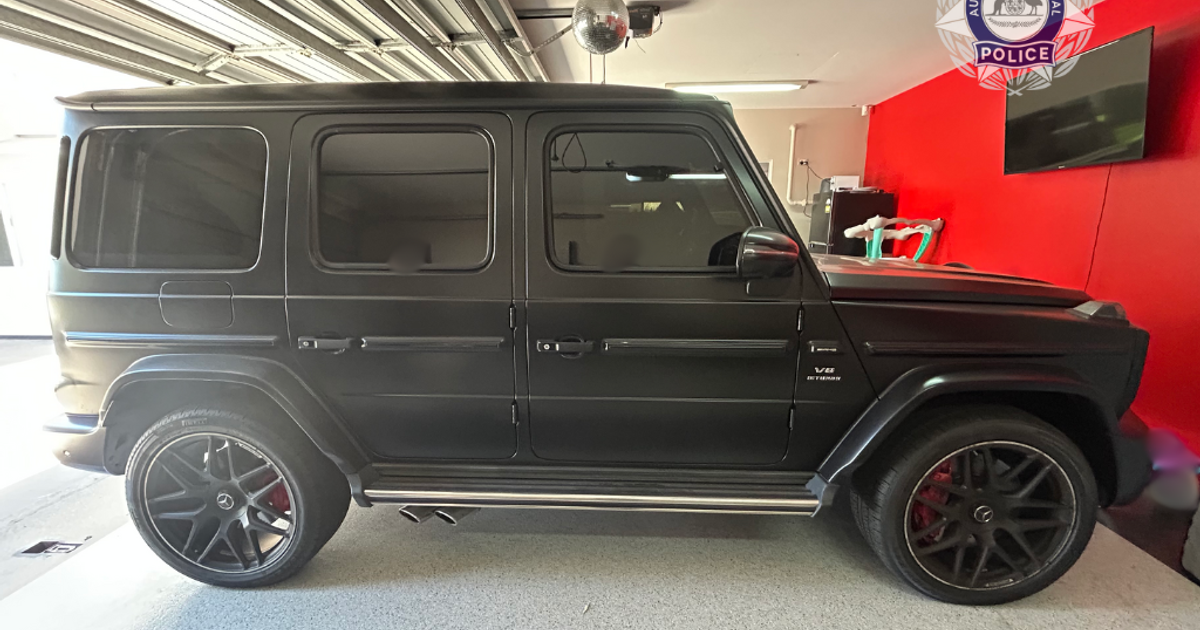
Darwin, Australia – December 2, 2025 – In a bold strike against Australia’s booming illicit tobacco trade, federal authorities have seized two luxury off-road icons—a Toyota LandCruiser 70 Series and a Mercedes-AMG G63—alongside properties, a jetski, and nearly $1 million in bank funds, totaling $8.4 million in suspected criminal proceeds. The Criminal Assets Confiscation Taskforce (CACT), spearheaded by the Australian Federal Police (AFP), moved swiftly after Northern Territory Police uncovered a massive haul of contraband cigarettes and vapes linked to a 27-year-old Queensland man.
The seizures, announced Monday, highlight the escalating war on black-market tobacco, which costs the Australian economy billions annually in lost tax revenue and fuels organized crime. The vehicles, prized for their rugged appeal among high-rollers and off-road enthusiasts, were restrained under proceeds-of-crime laws that allow authorities to target unexplained wealth without a full criminal conviction.
The Bust: From Street Sales to Luxury Seizures
The operation traces back to early 2024, when NT Police intercepted a suspicious shipment in Darwin. Over just four months—from February to June—they confiscated nearly 946,000 illegal cigarettes, more than 12,000 nicotine vapes, 86 kilograms of loose tobacco, 1,400 pouches bearing fake health warnings, and 644 nitrous oxide canisters. Officers suspected the goods were bound for underground sales in the Northern Territory’s remote communities, where illicit tobacco thrives due to high demand and lax enforcement.
What started as a routine bust evolved into a financial probe. AFP investigators, tipped off by NT counterparts, zeroed in on the Queensland suspect’s lavish lifestyle. His assets—far exceeding any declared income—raised red flags, prompting CACT to invoke the Proceeds of Crime Act. This legislation empowers police to freeze and ultimately forfeit items deemed “proceeds or instruments of crime” on a civil burden of proof, bypassing the higher criminal standard.
The haul includes:
- Vehicles: A battle-ready Toyota LandCruiser 70 Series, the no-frills workhorse beloved in Australia’s outback for its durability, and a Mercedes-AMG G63, the boxy brute synonymous with high-octane luxury (starting at over AUD $300,000).
- Properties: Two commercial sites—likely warehouses or fronts—and three homes, spanning Queensland and the NT.
- Other Assets: A high-speed jetski for coastal getaways, plus $1 million scattered across three bank accounts.
AFP Commander Jason Kennedy, leading the CACT, framed the action as a deterrent. “The AFP and our partners are committed to targeting the proceeds, instruments, and benefits of the illicit tobacco trade,” he said in a statement. The taskforce collaborates with heavyweights like the Australian Taxation Office (ATO) and Australian Border Force (ABF), pooling intel to dismantle syndicates that smuggle tobacco from Asia and dodge AUD $50 billion in annual excise duties.
The 27-year-old, unnamed pending charges, faces potential pecuniary penalty orders—fines matching his ill-gotten gains—and an “unexplained wealth declaration.” If proven, he could lose everything, even absent a direct conviction for smuggling.
The Illicit Tobacco Plague: A Billion-Dollar Shadow Economy
Australia’s tobacco black market has exploded since 2018’s tobacco tax hikes, which jacked prices to AUD $50 per pack. Organized crime groups, often tied to Middle Eastern or Asian syndicates, exploit porous borders, importing duty-free hauls via sea cargo or air passengers. The ABF reports seizing over 100 million sticks yearly, but experts estimate 20-30% of consumed tobacco evades taxes—equating to AUD $2-3 billion in annual losses.
In the NT, the issue hits harder. Remote Indigenous communities, where smoking rates top 50%, become prime markets for cheap, unregulated product laced with contaminants. Health advocates decry the vapes and nitrous oxide as gateways to youth addiction, while law enforcement links profits to drug trafficking and money laundering.
This isn’t the first high-profile tobacco takedown. In 2024, Operation Ironside netted AUD $50 million in assets from a Sydney-based ring, including Ferraris and waterfront mansions. But the CACT’s focus on “unexplained wealth” innovates: It lets cops claw back luxuries like the G63—often “G-Wagons” in street slang—without proving every dollar’s origin. Critics, including civil liberties groups, worry it risks overreach, ensnaring innocents in asset freezes that drag for years.
Vehicle Spotlights: From Bush Bashers to Bling Machines
The seized rides steal the show, embodying the irony of crime’s spoils. The Toyota LandCruiser 70 Series, unchanged since 1984, is an Australian legend—over 500,000 sold locally, prized for its ladder-frame toughness and V8 grunt. At AUD $75,000 base, it’s the ute of choice for miners and farmers, but in criminal hands, it hauls contraband across the red dirt. Globally, it’s banned in the U.S. due to “chicken tax” tariffs on light trucks, making imports rare collector’s items.
Contrast that with the Mercedes-AMG G63: A 577-horsepower beast with geländewagen heritage, it’s the celebrity SUV of rappers and oligarchs. In Australia, where G-Wagons fetch AUD $400,000 loaded, it’s a blatant status flex—hard to justify on a legit miner’s wage. Seizing one sends a message: Flashy wheels won’t shield dirty money.
On X (formerly Twitter), reactions poured in post-announcement. One user quipped, “From smuggling smokes to losing the G-Wagon—Darwin’s got receipts 😂 #TobaccoBust.” Another decried the trade’s toll: “Illicit cigs killing our mob up north. Good on AFP for hitting the wallets.” No major backlash yet, but off-road forums buzzed about the 70 Series’ “untouchable” rep taking a hit.
Experts weigh in too. Criminology professor from the University of Sydney, Dr. Elisa Haruni, told local media: “These seizures disrupt the glamour of crime—turning dream cars into evidence bags.” ABF Commissioner Michael Outram added that cross-agency ops like CACT are ramping up, with AI tracking financial anomalies to preempt hauls.
Ripple Effects: Economic Hits and Policy Shifts
For U.S. readers with eyes on global markets, this saga underscores trans-Pacific crime ties. American tobacco firms like Philip Morris lobby against illicit flows, but Australia’s model—steep taxes funding health programs—mirrors U.S. state-level hikes. The bust could inspire IRS-ICE collaborations, targeting luxury imports as laundering red flags.
Economically, it stings syndicates: Losing $8.4 million cramps ops, forcing diversification into meth or human smuggling. For communities, it’s a win—fewer vapes in schools, more tax bucks for roads. Toyota and Mercedes? Mere bystanders, though the irony amuses: Rugged icons funding vice.
As the case heads to court, expect more revelations. The AFP hints at wider probes, potentially netting co-conspirators. In a nation where tobacco kills 15,000 yearly, this seizure isn’t just about cars—it’s a throttle on a deadly engine.
By Mark Smith
Mark Smith covers international crime investigations and luxury asset seizures for [Your News Site]. Reach him at mark.smith@newsite.com.
Follow and subscribe to us for push notifications on the latest tobacco trade busts, luxury vehicle news, and global crime updates—stay seized!