Honda Recalls Nearly 99,000 Vehicles Due to Faulty Airbag Sensors
American Honda Motor Co. has issued a significant safety recall covering nearly 99,000 Honda and Acura vehicles in the United States. The issue involves the front passenger seat weight sensor, which is part of the system that determines whether airbags should deploy in a crash.
The recall was announced in late May 2026 and expands on an earlier, much larger campaign from 2024 for the same underlying problem.
What Happened
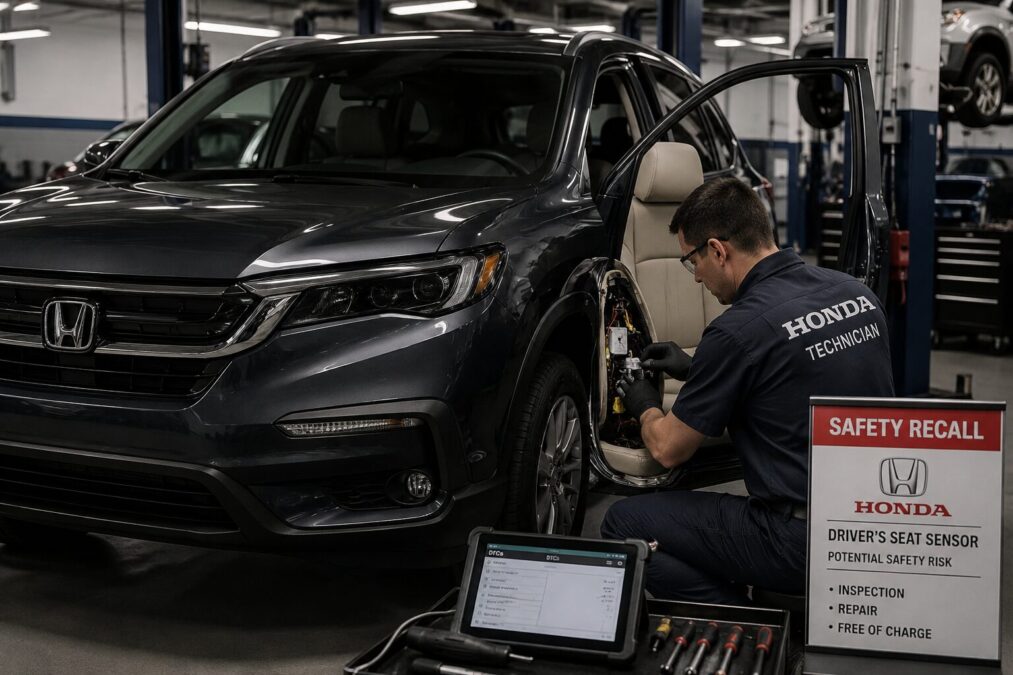
A capacitor on the printed circuit board inside the front passenger seat weight sensor can crack over time when exposed to environmental humidity. This cracking can create an internal short circuit.
When that happens, the vehicle’s occupant classification system may not correctly identify a small passenger — such as a child in a car seat or a smaller adult — and could fail to suppress the front passenger frontal and knee airbags. In a crash, those airbags could then deploy at full force when they should remain off, raising the risk of injury.
Honda traced the root cause to a temporary change in circuit board material by a supplier following a natural disaster at one of its plants. The alternative material was not fully validated for this application.
Affected Vehicles
The recall covers an estimated 98,892 vehicles across numerous popular Honda and Acura models from the 2016 through 2026 model years. It is not a blanket recall of every Honda vehicle ever made.
Affected models include:
- Honda: Accord and Accord Hybrid (2016–2022), Civic (various body styles 2016–2022, including Type R in select years), CR-V and CR-V Hybrid, Fit, HR-V, Insight, Odyssey (up to 2026), Passport, Pilot, and Ridgeline (select years).
- Acura: MDX, RDX, and TLX (specific year ranges).
Exact model-year combinations vary. Newer vehicles built after early 2022 generally use the corrected sensor design. Owners should not assume their vehicle is affected simply because it is a Honda or Acura.
Why It Matters
Airbag systems are designed with multiple layers of protection, including suppression logic for vulnerable occupants. When that logic fails, the very safety feature meant to protect passengers can become a hazard — particularly for children and smaller adults in the front seat.
No injuries have been reported in connection with this specific defect so far, according to available information. However, there have been warranty claims related to the issue. Vehicle recalls exist precisely to address these kinds of latent safety risks before they result in harm.
Background and Prior Recall
This 2026 action is an expansion of a much larger recall Honda conducted in 2024 that covered more than 750,000 vehicles for the identical sensor concern. The latest campaign addresses additional vehicles that were not included in the earlier round or that required further remediation.
The National Highway Traffic Safety Administration (NHTSA) oversees these campaigns. Honda is required to notify owners and provide free repairs.
Public Reaction and Owner Advice
News of the recall has prompted many owners to check their vehicles immediately. Social media discussions reflect both concern about the potential airbag issue and appreciation that Honda is addressing it proactively.
Honda and Acura dealers will replace the defective seat weight sensor with a redesigned unit that uses the original, verified circuit board material. The repair is free of charge.
Owners can determine if their vehicle is included by:
- Visiting recalls.honda.com or recalls.acura.com
- Calling Honda/Acura customer service at 888-234-2138
- Checking their VIN on the NHTSA website
What’s Next
Owner notification letters are scheduled to begin mailing around July 6, 2026. Dealers have already been notified and are prepared to perform the repairs.
Honda has also improved its supplier processes for material validation and traceability to help prevent similar issues in the future. Production vehicles built after January 2022 incorporate the corrected sensor design.
Conclusion
This recall highlights the complexity of modern vehicle safety systems and the importance of timely manufacturer action when defects are identified. While the number of vehicles involved is substantial, the targeted nature of the campaign — focused on specific model years and a single component — shows how automakers and regulators work to address risks efficiently.
Any Honda or Acura owner with a vehicle from the affected years should verify their VIN promptly. A quick check at a dealership could prevent a serious safety issue in the event of a crash.
Source: RealNewsHub.com
Written for American audiences by the RealNewsHub Editorial Team.